Does AEO Replace SEO? What Website Owners Should Know
The search landscape has experienced a seismic shift. If you have been monitoring your website’s analytics recently, you have likely noticed a change in how users find your content. Consumers are no longer just typing fragmented keywords into a search bar and scrolling through blue links; they are asking full,conversational questions to AI assistants, chat-based platforms, and AI Overviews. In fact, nearly 49% of clicks from traditional search have already been lost to AI-generated answers, and that share continues to grow.
This evolution has sparked a massive debate in the digital marketing community, introducing a new acronym to the boardroom: AEO (Answer Engine Optimization).
Website owners are understandably anxious, asking a critical question: Is SEO dead? Does AEO replace it?
The short answer is no. AEO does not replace SEO. However, ignoring AEO means you are optimizing for the past. To maintain and grow digital visibility in 2026, modern brands must integrate both strategies. Here is a deep dive from our expert marketing studio into exactly what AEO is, how it differs from traditional SEO,and the actionable steps website owners must take to thrive in the era of answer engines.
The Foundation: What is SEO in the AI Era?
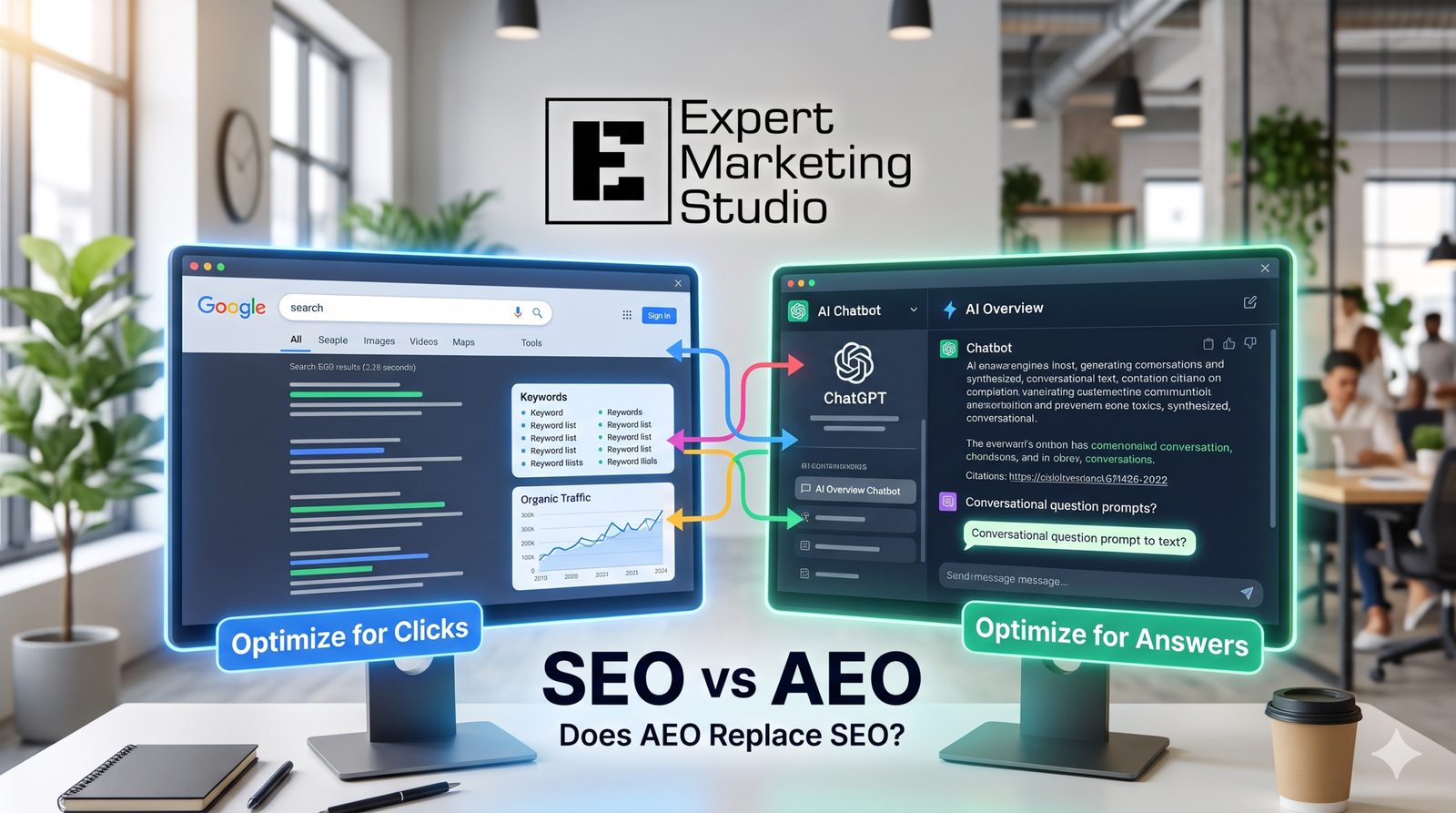
Search Engine Optimization (SEO) has always been about visibility, but its ultimate goal is driving clicks and capturing organic traffic. SEO is the practice of earning visibility in regular search results on engines like Google and Bing.
SEO optimizes your brand to rank in traditional search result layouts. It relies heavily on crawlability, site structure, indexation, and building domain authority through backlinks and technical health.
When users have broad intents—such as comparing multiple software tools, researching a deep topic, or navigating to a specific brand—they turn to search engines. SEO ensures that when a user types a query like “eCommerce Shipping Solutions India,” your comprehensive guide ranks on page one. It provides the broader foundation that makes your website discoverable in the first place.
The Evolution: Enter Answer Engine Optimization (AEO)
While SEO wants the click, Answer Engine Optimization (AEO) wants the citation.
AEO focuses on optimizing content so that it can be cited, quoted, and recommended in AI-generated answers by platforms like ChatGPT, Perplexity, Gemini, and Google’s AI Overviews. Instead of focusing solely on ranking an entire webpage, AEO considers whether a specific section of that page clearly and directly answers a user’s question.
The difference in user behavior is stark. A search engine gives a user a list of documents and forces them to decide which one to read; an answer engine reads a multitude of sources and synthesizes a direct response. If your content is structured correctly, AI tools will pull your words into their answers and credit you for them—meaning AEO helps you get mentioned in the answer that shows up before traditional links,or even instead of them.
The GEO Overlap
You may also hear the term GEO (Generative Engine Optimization). While the terminology overlaps, GEO specifically focuses on how brands appear inside AI-generated responses, whereas AEO also encompasses featured snippets and voice search optimization. Ultimately, they serve the same overarching goal: making your content the chosen answer for AI.
SEO vs. AEO: The Core Differences
Winning at SEO does not guarantee winning at AEO, and vice versa. In fact, research shows that only 35% of URLs cited in Google AI Mode match Google’s organic top 10—meaning strong SEO rankings alone do not translate directly into AI visibility.
Here is how the two disciplines diverge across key dimensions:
| Dimension | Traditional SEO | Answer Engine Optimization (AEO) |
| Primary Goal | Ranking full pages to drive organic traffic and earn the “click”. | Being the “chosen source” to be extracted and cited as a direct answer. |
| Target Queries | Keyword-based queries (e.g., “best running shoes”) accommodating research and transactional intent. | Question-based queries (e.g., “What are the best running shoes for flat feet?”) reflecting conversational phrasing. |
| Content Structure | Long-form content built around topic clusters, prioritizing depth and comprehensive context. | Short, extractable answer blocks placed high on the page (usually ~40 to 60 words). |
| Technical Focus | Page performance, metadata, internal linking, and domain authority. | Schema markup (especially FAQ), entity clarity, and consistent brand terminology. |
| Success Metrics | Keyword rankings, organic sessions, and conversion rates tracked via Search Console. | Visibility in AI Overviews, brand mentions by ChatGPT/Perplexity, and zero-click performance. |
Why AEO Does Not Replace SEO (The Symbiosis)
It is tempting to look at the rise of ChatGPT and assume traditional SEO is obsolete. But businesses treating SEO and AEO as competing strategies are making a critical mistake.
AEO does not replace SEO; it builds upon it.
Search engines and AI systems both need to discover, crawl, interpret, and evaluate information before they can serve it. If your pages are not technically accessible, indexed, and trusted by search engines, no answer engine is going to cite them. SEO provides the access and the foundational trust (crawlability), while AEO provides the synthesizability (the answer).
Furthermore, they share vital common ground. Both disciplines reward content that is genuinely useful,factually accurate, and clearly written. Both benefit from a technically healthy site and strong E-E-A-T (Experience, Expertise, Authoritativeness, and Trustworthiness) signals.
The relationship is inherently symbiotic: strong SEO fuels AEO success because AI systems heavily favor content from trusted domains with established authority, and AEO ensures that this authoritative content is formatted so AI can actually understand and use it.
Actionable Strategies: How Website Owners Can Optimize for Both
For most businesses in 2026, the only practical path forward is integrating both into a unified content strategy. SEO gets you found; AEO gets you cited.
Here is how our marketing studio recommends optimizing your website to win in both arenas.
1. Write Around Questions, Not Just Keywords
SEO starts with a keyword; AEO starts with a question. Instead of relying on rigid keyword insertion, identify the exact questions your audience is asking. Use features like Google’s “People Also Ask,” autocomplete,and conversational prompts to find these questions.
- The SEO Approach: “Digital Marketing Services”
- The AEO Approach: “What are the most effective Digital Marketing Services for local businesses?”
2. Restructure Content for “Answer First” Extraction
AEO requires you to give the answer immediately, rather than burying it at the bottom of a 2,000-word post.
- Rewrite Headings: Turn your H2s and H3s into natural, conversational questions.
- The 40-60 Word Rule: Directly beneath the question heading, provide a concise, direct answer in the first two sentences (aiming for 40 to 60 words).
- Elaborate After: Once you have provided the clear, extractable answer block, use the rest of the section to provide the deep, comprehensive context that traditional SEO demands.
3. Implement Robust Schema Markup
Technical SEO remains paramount, but AEO demands specific structured data. Implementing Schema Markup helps AI systems map out the meaning of your content. Adding FAQ Schema to your most important pages makes your question-and-answer format explicitly clear to both search crawlers and AI bots.
4. Publish Original, Research-Backed Content
Both AI search platforms and traditional engines reward content grounded in real experience that generative AI cannot fabricate on its own.
- Share First-Hand Experience: Document experiments, run surveys, and pull insights from your own internal data.
- Leverage Experts: If you lack direct experience on a sub-topic, quote industry experts. This adds depth and signals profound trust to both human readers and AI models.
5. Build an Unshakeable Brand Entity
AI answer engines synthesize information from across the entire web. To be cited as an authority, your brand must look consistent everywhere. Ensure your terminology, product descriptions, and core value propositions are unified across your website, PR mentions, industry publications, and social media. You are building genuine credibility and a distinct digital entity, not just chasing backlinks.
6. Monitor Your AI Visibility Proactively
Unlike SEO, where Google Search Console neatly packages your impressions and clicks, AEO requires active investigation. You cannot rely on a single dashboard. To measure your AEO success, pick 15 to 20 core questions relevant to your industry, open ChatGPT, Perplexity, and Google AI Overviews, and manually search them. Monitor whether your brand is mentioned, if your links are cited, and track your referral traffic from identifiable AI sources.
The reality for website owners is clear: more people are getting their answers directly from AI tools without ever clicking traditional search results. If your brand is not mentioned within those AI-generated answers,you will lose visibility before the user even has a chance to visit your website.
However, pivoting entirely to AEO while abandoning SEO technical health, site speed, and deep content will cause your visibility to collapse across all fronts. SEO remains the sturdy foundation of your digital house,while AEO is the structural design that allows modern AI assistants to seamlessly walk through the front door. By answering questions directly, formatting for easy extraction, and maintaining unparalleled domain authority, you secure your brand’s place as the definitive expert—no matter which engine your customer uses to search.