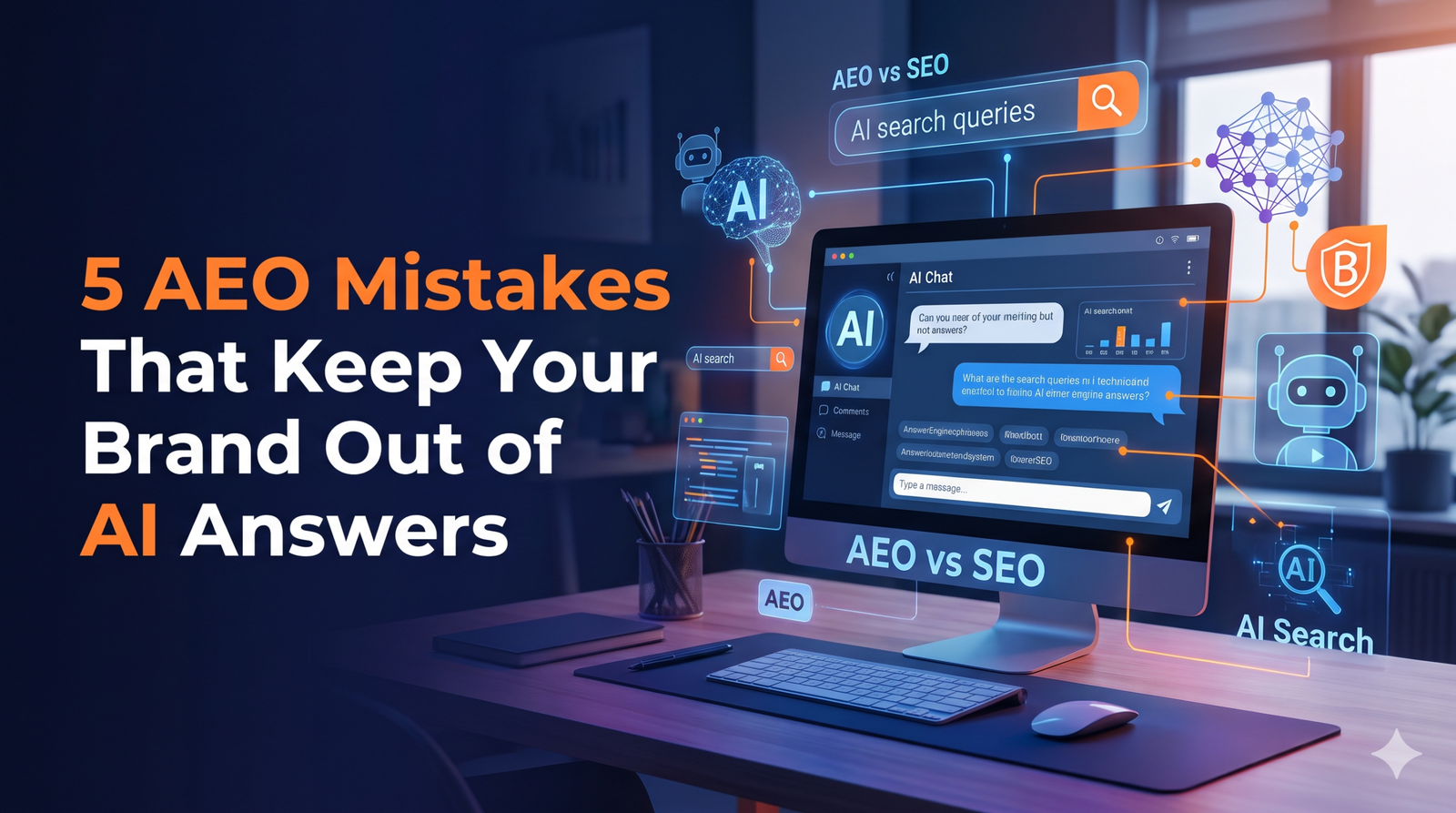
5 AEO Mistakes That Keep Your Brand Out of AI Answers
The era of ten blue links is officially over.
If you’ve searched for anything online recently, you’ve likely noticed a massive shift in how information is delivered. Google’s AI Overviews (formerly SGE), Perplexity AI, ChatGPT, and Claude are fundamentally changing the digital landscape. Users are no longer just searching—they are asking. And increasingly, they are getting instant, synthesized answers directly at the top of their screens, without ever needing to click a traditional search result.
For digital marketers and brand owners, this shift demands a radical evolution in strategy. Enter Answer Engine Optimization (AEO).
AEO is the process of optimizing your digital presence so that Artificial Intelligence models and conversational search engines cite your brand as the definitive source. If your SEO strategy hasn’t evolved to include AEO, your brand is rapidly becoming invisible to the next generation of consumers.
At Expert Marketing Studio, we’ve analyzed how Large Language Models (LLMs) and retrieval-augmented generation (RAG) systems parse the web. Time and again, we see businesses with massive traditional SEO budgets completely left out of AI-generated answers.
Why? Because optimizing for a traditional crawler is not the same as optimizing for an Answer Engine.
In this comprehensive guide, we are breaking down the 5 critical AEO mistakes that are keeping your brand out of AI answers—and providing actionable, step-by-step frameworks to fix them.
Mistake #1: Clinging to Traditional Keyword Strategies (Ignoring the “Conversational Shift”)
For two decades, SEO was dominated by short-tail, fragmented keywords. A user looking for a marketing agency would type “digital marketing agency New York.” Today, a user speaking to ChatGPT or Perplexity is far more likely to ask: “What are the most highly-rated digital marketing agencies in New York that specialize in B2B SaaS companies?”
The Problem: Speaking Crawler, Not Human AI search engines use Natural Language Processing (NLP) to understand intent, context, and nuance. If your content is built purely around stuffing short-tail keywords (“buy shoes online,” “best CRM software”), you are failing to provide the semantic depth that LLMs crave.
AI doesn’t just match keywords; it matches concepts. When a user asks a highly specific, multi-layered question, the AI looks for content that answers that exact question in a natural, conversational tone. If your content reads like a robotic SEO template from 2015, the AI will bypass it in favor of a source that sounds human and authoritative.
The Impact on Your Brand By ignoring conversational queries, you miss out on the highest-intent traffic. Users who ask long, detailed questions are usually further down the sales funnel. If an AI cannot synthesize a direct answer from your pages, it will pull from your competitors who have embraced conversational content.
How to Fix It: Shift to Question-Based Content
To optimize for AI, you must transition from a “Keyword” mindset to a “Query and Context” mindset.
- Map the Conversational Journey: Stop looking only at search volume tools. Start looking at tools like AnswerThePublic, Reddit, Quora, and customer support logs. What exact phrases and questions are your actual customers asking?
- Target “Who, What, Where, When, Why, and How”: Answer Engines are designed to answer questions. Your content must explicitly pose and answer these questions.
- Adopt Semantic SEO: Group your content into topic clusters rather than isolated keyword pages. If you are writing about “Content Marketing,” your page should naturally include semantically related terms like “editorial calendar,” “audience personas,” “distribution channels,” and “ROI tracking.”
- Use Natural Language: Read your content out loud. If it sounds unnatural or forced, an LLM will likely deprioritize it. Write as if you are explaining the concept to a highly intelligent colleague.
Expert Marketing Studio Tip: Create a dedicated “Glossary” or a robust “FAQ” hub on your website. Use actual H2 and H3 tags to ask the exact questions your users are asking, and immediately provide the answer directly below it.
Mistake #2: Burying the Lead (Poor Content Formatting and Structure)
We’ve all seen them: the recipe blogs that require you to read a 1,500-word story about the author’s grandmother before actually giving you the ingredients for the chocolate chip cookies.
In traditional SEO, long “dwell time” was historically seen as a positive signal, leading marketers to pad their content with fluff. In the world of AEO, this is a fatal error.
The Problem: Making the AI Work Too Hard Retrieval-Augmented Generation (RAG) models—the technology behind most AI search engines—scan documents to extract specific facts to feed into the language model. They operate on efficiency. If the direct answer to a user’s query is buried in the 14th paragraph of a massive wall of text, the AI will simply extract the answer from a different website that presented it more clearly.
AI engines prioritize content that is highly structured, easily skimmable, and logically organized.
The Impact on Your Brand Even if you have the most accurate and insightful information on the internet, poor structure will render it invisible to AI. You will lose the “featured snippet” and the AI citation to a competitor who simply formatted their lesser content better.
How to Fix It: The Inverted Pyramid and Structured Data
You need to serve your answers on a silver platter.
- Embrace the Inverted Pyramid: Borrow this concept from journalism. Start with the most critical information—the direct answer—at the very top of the section. Follow it with supporting details, and leave the background/fluff for the very bottom.
- The “Bite, Snack, Meal” Approach:
- The Bite: A concise, 40-50 word direct answer to a specific question (perfect for AI extraction).
- The Snack: Bullet points or a small table elaborating on the answer.
- The Meal: The long-form paragraphs providing deep, expert context.
- Aggressive Use of HTML Tags: AI relies on HTML structure to understand content hierarchy. Use
<h2>for primary questions,<h3>for sub-questions, and<ul>/<ol>for lists. Never use bold text to fake a heading; use actual heading tags. - Implement Schema Markup (Structured Data): Schema is code you put on your website to help search engines return more informative results. For AEO,
FAQPage,Article,HowTo, andQAPageschemas are non-negotiable. It explicitly tells the AI: “Here is the question, and here is the exact answer.”
Expert Marketing Studio Tip: Audit your top 10 highest-traffic blogs. Look at the H2 headings. Directly beneath each H2, insert a bolded, 2-sentence summary that explicitly answers the heading. Watch how quickly your AI citations increase.
Mistake #3: Neglecting Entity SEO and Your Knowledge Graph
This is perhaps the most technical, yet most critical, mistake brands make in the AEO era.
Traditional SEO treated words as “strings” (a sequence of characters). AI and modern search engines treat words as “things” (Entities).
The Problem: You Are Not an Established Entity An entity is a uniquely identifiable person, place, concept, or brand. Google maintains a massive database called the Knowledge Graph, which maps how all these entities connect.
If an AI doesn’t recognize your brand, your CEO, or your core products as established entities with clear relationships to your industry, it will not trust you as a source. If the AI doesn’t “know” who you are, it won’t recommend you.
Many businesses operate as digital ghosts. They have a website, but they lack a cohesive digital footprint that proves their existence and authority to a machine.
The Impact on Your Brand When a user asks ChatGPT, “What are the best boutique marketing agencies for real estate?”, the AI isn’t just scraping the web in real-time. It is looking into its training data and knowledge graphs to find entities historically associated with “boutique marketing,” “real estate,” and “high quality.” If your entity isn’t firmly established, you won’t make the list.
How to Fix It: Build and Connect Your Entities
You must actively train the AI on who you are.
- Claim and Optimize Your Knowledge Panels: Ensure your Google Business Profile is meticulously updated. If you qualify, claim your Google Knowledge Panel.
- Utilize
OrganizationandPersonSchema: Use structured data to explicitly define your brand entity. Use theSameAsattribute in your schema to link your website to your verified social media profiles, Wikipedia page (if applicable), Crunchbase profile, and authoritative directory listings. This connects the dots for the AI. - Establish Author Entities: AI models highly value E-E-A-T (Experience, Expertise, Authoritativeness,Trustworthiness). Articles shouldn’t be published by “Admin.” They should be published by a specific person with a detailed author bio, links to their LinkedIn, and
Personschema. The AI needs to know the author is a real,credible expert. - Maintain Consistent NAP: Name, Address, and Phone number consistency across the entire web is foundational. Inconsistencies confuse the AI and fracture your entity identity.
Expert Marketing Studio Tip: Build an “About Us” page that isn’t just marketing copy. Treat it as an entity-building page. State exactly what your company is, when it was founded, who the key executives are, and link out to authoritative third-party mentions of your brand.
Mistake #4: Operating in a Vacuum (Ignoring Digital PR and AI Consensus)
In the past, you could rank a website simply by having great on-page content and buying a few backlinks. Today, AI engines act like digital journalists. They don’t just take your word for it; they look for consensus.
The Problem: The “Echo Chamber” Effect If the only place on the internet that says your brand is “the best marketing agency” is your own website, AI models will ignore the claim. LLMs are trained on vast datasets encompassing the entire web, including forums, news sites, directories, and social media.
If an AI engine is asked to recommend a product or service, it looks for sentiment and consensus across multiple independent sources. If you lack third-party validation, you lack authority in the eyes of the AI.
The Impact on Your Brand You could have the most beautifully optimized website in the world, but if a user asks Perplexity, “What do people think about [Your Brand]?”, and there are no Reddit threads, Quora discussions, or third-party reviews mentioning you, the AI will either hallucinate an answer, state it doesn’t have enough information, or worse—recommend a competitor who is actively talked about.
How to Fix It: Digital PR and “Off-Page” AEO
You must get other reputable entities to talk about your entity.
- Target Information Hubs and Forums: AI models heavily weight platforms like Reddit, Quora, and industry-specific forums because they represent real human consensus and experience. Actively participate in these communities. Answer questions thoroughly and naturally mention your brand where it genuinely adds value.
- Earn Unlinked Brand Mentions: While traditional SEO is obsessed with backlinks, AEO values the mentionitself. If Forbes or TechCrunch mentions your brand name (even without a link), the AI registers that relationship and boosts your entity’s authority.
- Aggressively Manage Reviews: Reviews on Google, G2, Trustpilot, Yelp, and Clutch are critical data points for AI. Implement a system to consistently generate positive, detailed reviews from your clients. Respond to all reviews, using natural language that reinforces your core services.
- Get Featured in Listicles: AI engines frequently pull from existing “Top 10” lists. Run a digital PR campaign to get your brand included in established listicles and roundups in your industry.
Expert Marketing Studio Tip: Monitor what AI is currently saying about you. Regularly prompt ChatGPT, Claude, and Google SGE with queries like: “What are the pros and cons of [Your Brand]?” and “Who are the top competitors to [Your Brand]?” Use the outputs to identify gaps in your third-party presence.
Mistake #5: Forgetting the Multi-Modal and Technical Foundation
AI is no longer just text. When a user asks an AI search engine a question today, the response is often a rich tapestry of text summaries, YouTube video embeds, shopping product cards, and interactive maps.
The Problem: Having a Text-Only Strategy on a Slow Website If you are only optimizing blog posts, you are missing out on a massive portion of AI real estate. Furthermore, if your website is plagued by technical issues—slow loading times, broken JavaScript, inaccessible pages—the AI’s crawler bots will simply abandon your site.
AI engines require clean, fast, and accessible code to extract information efficiently. If your site takes 6 seconds to load, the RAG system will time out and move to a competitor.
The Impact on Your Brand When a user asks an AI, “How do I fix a leaky faucet?”, the AI wants to show a video alongside the text. If you only have text, you lose out to the competitor who provided a clear, transcript-optimized YouTube video. If you are an e-commerce brand and your product feeds aren’t optimized, the AI will not feature your products in its conversational shopping features.
How to Fix It: Multi-Modal Optimization and Technical Excellence
You must serve content in every format the AI wants to consume, built on a flawless technical foundation.
- Optimize Video Content: AI engines heavily rely on YouTube (especially Google’s SGE). For every major piece of content you produce, create a corresponding video. Crucially, upload a highly accurate, human-edited transcript. Break the video into chapters with distinct timestamps that answer specific questions. The AI will parse this transcript to serve your video in direct answers.
- Image Optimization and Alt Text: AI vision models are incredibly advanced, but they still rely on context. Use descriptive, conversational Alt Text for your images. Instead of
alt="marketing graph", usealt="bar chart showing the 50% increase in ROI after implementing Answer Engine Optimization strategies." - Feed Optimization for E-commerce: If you sell products, ensure your Google Merchant Center feeds are flawless. Use extensive, highly descriptive product attributes (color, size, material, compatibility) so the AI can answer hyper-specific shopping queries accurately.
- Prioritize Core Web Vitals: Ensure your site is blazing fast. Compress images, minify code, and ensure your server response times are minimal. The easier you make it for an AI bot to crawl your site, the more likely you are to be cited.
- Ensure JavaScript Accessibility: Many AI crawlers struggle with client-side rendered JavaScript. Ensure that the core text content and links you want the AI to read are present in the initial HTML payload (Server-Side Rendering).
Expert Marketing Studio Tip: Conduct a comprehensive technical audit focusing specifically on crawl budget and page speed. Use tools like Google Search Console to ensure no critical “answer” pages are blocked by
robots.txtor buried behind complex JavaScript navigation.
The Future is Conversational: Are You Ready?
Answer Engine Optimization is not a fad; it is the natural evolution of how humans interact with the internet. We are moving from a paradigm of searching for links to demanding instant knowledge.
The brands that will dominate the next decade of digital marketing are the ones who stop trying to trick algorithms with keyword stuffing and start focusing on providing clear, structured, and authoritative answers to real human questions.
By avoiding these 5 critical mistakes—shifting to question-based content, structuring for extraction, building your brand entity, driving third-party consensus, and optimizing for multi-modal AI—you can position your brand as the definitive source of truth in your industry.
Don’t let your brand become a digital ghost in the AI era.
At Expert Marketing Studio, we specialize in transitioning traditional SEO campaigns into forward-thinking AEO strategies. We build your brand entity, structure your content for LLM extraction, and drive the digital PR needed to make AI engines trust you.
Ready to dominate the AI search results? Contact Expert Marketing Studio today for a comprehensive Answer Engine Readiness Audit. Let’s make sure that when the world asks AI a question, your brand is the answer.
Want to know how we audit a site for AEO?