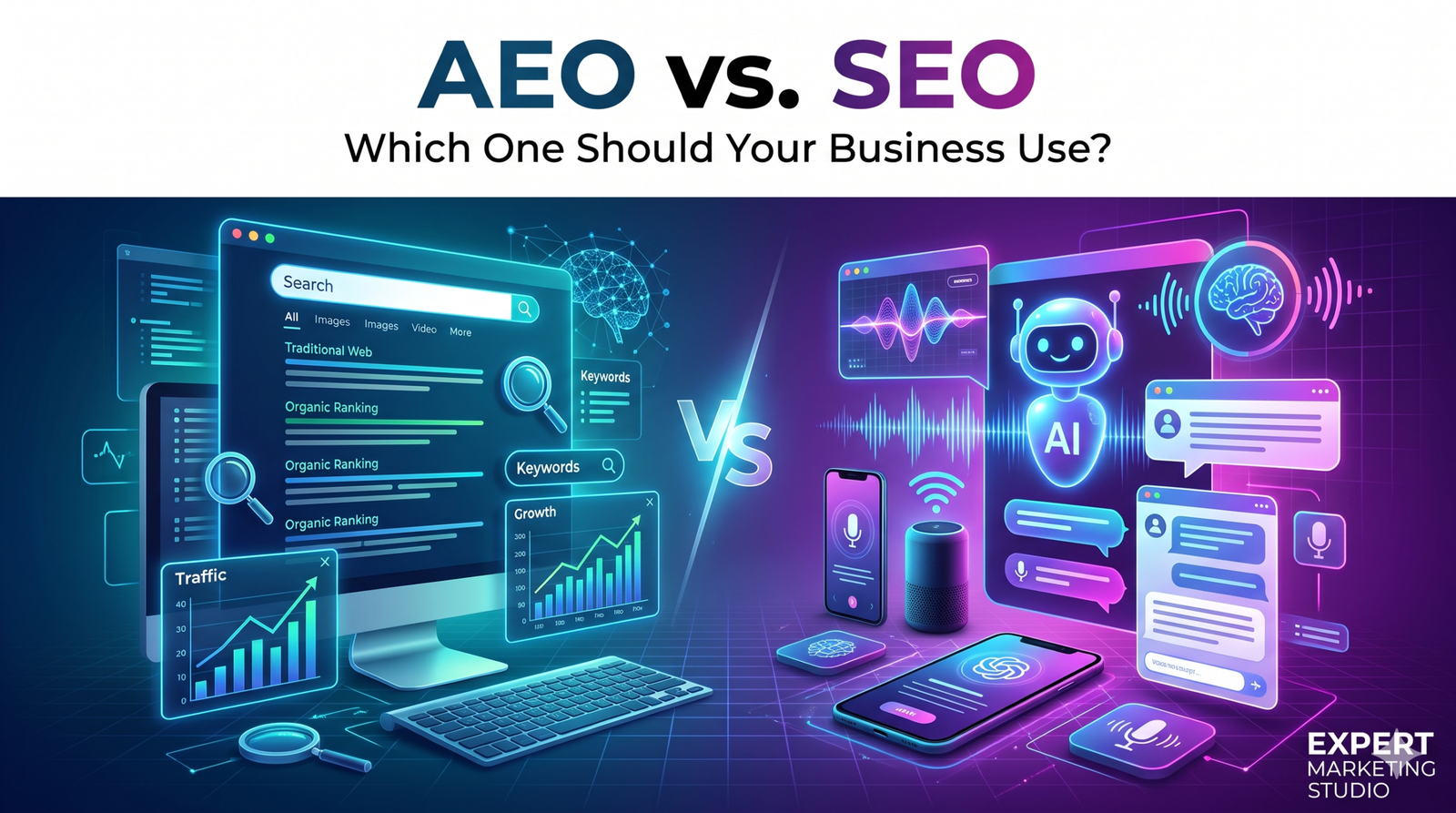
AEO vs. SEO: Which One Should Your Business Use?
The digital landscape is undergoing a seismic shift. For over two decades, Search Engine Optimization (SEO) has been the undisputed king of digital marketing. If you wanted your business to be found, you optimized for Google’s search algorithms. But today, a new challenger has entered the arena, fundamentally changing how users find information: Answer Engine Optimization (AEO).
With the rise of AI-powered search experiences like Google’s Search Generative Experience (SGE), ChatGPT, Perplexity, and Claude, users are no longer just “searching” for links; they are “asking” for answers.
So, as a business owner or marketer, where should you invest your time and budget? Do you stick to traditional SEO, or do you pivot entirely to AEO?
At Expert Marketing Studio, we field this question daily. In this ultimate guide, we will break down exactly what SEO and AEO are, how they differ, the unique benefits of each, and how you can combine them to dominate the digital landscape in 2026 and beyond.
Part 1: The Evolution of Information Discovery
To understand the AEO vs. SEO debate, we first need to understand how user behavior has evolved.
The Era of the Blue Links (Traditional SEO)
Historically, the search process looked like this:
- A user types a fragmented keyword phrase into Google (e.g., “best running shoes 2026”).
- Google’s algorithm crawls, indexes, and ranks millions of pages.
- The user is presented with “10 blue links.”
- The user clicks on a link, reads the content, and if it doesn’t satisfy their query, hits the back button to try another link.
This model is built on navigation. The search engine is a directory, guiding the user to a destination where the answer might live.
The Rise of the AI Answer Engine (The AEO Era)
Today, the paradigm is shifting from navigation to direct resolution.
- A user asks a conversational question (e.g., “What are the best running shoes for someone with flat feet who runs 15 miles a week on pavement?”).
- An AI-driven Answer Engine (like ChatGPT or Google’s AI Overviews) synthesizes information from across the web.
- The user is presented with a direct, comprehensive answer right on the results page.
- The user gets their answer instantly, often without clicking a single external link (a phenomenon known as the “zero-click search”).
This shift means your business isn’t just competing to be a link on a page; you are competing to be the source of truththat feeds the AI’s answer.
Part 2: What is SEO (Search Engine Optimization)?
Defining SEO
Search Engine Optimization (SEO) is the strategic process of improving a website’s visibility in organic (non-paid) search engine results pages (SERPs). The goal is to drive high-quality, targeted traffic to your website by ranking highly for specific keywords relevant to your products or services.
The Core Pillars of SEO
SEO is typically broken down into three main categories:
- On-Page SEO: This involves optimizing the content and structure of individual web pages. It includes keyword research, creating high-quality content, optimizing title tags, meta descriptions, header tags (H1, H2, H3), and ensuring a seamless user experience (UX).
- Technical SEO: The backend foundation of your website. Technical SEO ensures search engine spiders can easily crawl and index your site. This covers site speed optimization, mobile responsiveness, XML sitemaps, robots.txt, and site architecture.
- Off-Page SEO: Activities conducted outside of your website to impact your rankings. The primary focus here is link building (acquiring high-quality backlinks from reputable sites), which serves as a “vote of confidence” in the eyes of search engines.
The Pros of SEO
- Predictable Traffic Generation: Ranking #1 for a high-volume keyword guarantees a steady stream of traffic to your site.
- Deep User Engagement: Because users land on your website, you have total control over their experience, allowing you to guide them through your sales funnel.
- Brand Authority: Consistently appearing at the top of Google searches builds immense trust with consumers.
- Measurable ROI: Tools like Google Analytics and Google Search Console make it easy to track clicks, impressions, and conversions.
The Cons of SEO
- Highly Competitive: Everyone is fighting for page one. Breaking into the top spots for competitive keywords can take months or even years.
- Algorithm Volatility: A sudden Google core update can tank your rankings overnight.
- Resource Intensive: Good SEO requires continuous content creation, technical maintenance, and proactive link building.
Part 3: What is AEO (Answer Engine Optimization)?
Defining AEO
Answer Engine Optimization (AEO) is the process of optimizing your digital content so that it is easily digestible, understandable, and extractable by Artificial Intelligence models and Answer Engines. The goal of AEO is to be the primary source cited when an AI generates a direct answer to a user’s question.
Answer engines include Google’s SGE/AI Overviews, Bing Chat (Copilot), ChatGPT, Perplexity AI, Apple’s Siri, and Amazon’s Alexa.
The Core Pillars of AEO
AEO focuses less on keywords and more on context, clarity, and entities:
- Entity Optimization: Answer engines think in terms of “entities” (people, places, concepts, things) rather than strings of text. AEO involves clearly defining who you are, what you do, and building a Knowledge Graph around your brand.
- Question-and-Answer Formatting: Structuring content to directly mirror how users ask questions. This means using natural language, concise definitions, and clear FAQ sections.
- Structured Data (Schema Markup): Code injected into your website that tells AI exactly what your content means. Schema can identify a block of text as a recipe, a review, a product, or a direct answer to a question.
- Credibility and E-E-A-T: Experience, Expertise, Authoritativeness, and Trustworthiness are crucial. AI models are trained to pull from highly credible, fact-checked sources to avoid “hallucinations.”
The Pros of AEO
- Visibility in “Zero-Click” Searches: Even if a user doesn’t visit your site, being cited by an AI engine builds immense brand awareness and authority.
- Capturing Voice Search: Voice assistants rely entirely on AEO to read answers out loud to users.
- High Conversion Intent: Users asking highly specific, conversational questions are often further down the purchasing funnel.
- Future-Proofing: As AI continues to dominate tech, AEO ensures your brand isn’t left behind.
The Cons of AEO
- Lower Direct Website Traffic: If the AI answers the question entirely, the user has no reason to click through to your website.
- Difficult to Track: Currently, measuring analytics for AEO (like how many times ChatGPT mentioned your brand) is incredibly difficult and lacks the precise metrics of traditional SEO.
- Less Control Over the Funnel: You cannot control the user journey if they never leave the answer engine’s interface.
Part 4: AEO vs. SEO – The Key Differences
To determine which strategy is best, we must contrast them directly.
| Feature | SEO (Search Engine Optimization) | AEO (Answer Engine Optimization) |
|---|---|---|
| Primary Goal | Drive clicks and traffic to your website. | Provide immediate, direct answers within the engine. |
| User Intent | Research, browsing, exploration, comparison. | Immediate resolution, fact-finding, quick assistance. |
| Search Queries | Short-tail and medium-tail keywords (e.g., “CRM software”). | Long-tail, conversational questions (e.g., “Which CRM software integrates best with Shopify for a small business?”). |
| Content Focus | Long-form articles, landing pages, keyword density. | Concise, direct answers, FAQs, definitions, structured data. |
| Success Metric | Organic traffic, rankings, click-through rates (CTR), conversions. | Brand mentions, citations in AI answers, feature snippet acquisition. |
| The “Customer” | The Human Reader (and the web crawler). | The AI Language Model (LLM). |
Part 5: Why Your Business Still Needs Traditional SEO
Despite the hype around AI, traditional SEO is not dead. In fact, for many businesses, it remains the primary driver of revenue. Here is why you must maintain a robust SEO strategy with Expert Marketing Studio:
1. Complex Purchases Require Exploration
If a user is asking, “What is the capital of France?” an Answer Engine is perfect. However, if a user is searching for “Best B2B marketing automation software,” they don’t just want a one-paragraph AI summary. They want to read reviews, compare pricing tiers, watch demo videos, and explore different vendor websites. High-consideration purchases rely on the deep exploration that traditional SEO facilitates.
2. E-commerce and Visual Shopping
When people shop for clothes, furniture, or home decor, they want to browse images, read user reviews, and experience the brand’s aesthetic. AI text answers cannot replace the visual and interactive experience of navigating a well-optimized e-commerce store.
3. Traffic Equals Revenue
For businesses that rely on website traffic for monetization (like publishers running display ads, or affiliate marketers), zero-click searches are detrimental. Traditional SEO is essential for driving users actually to land on your pages so they can be monetized.
4. Lead Nurturing and Retargeting
When a user clicks on an SEO-optimized link and visits your site, you capture their data. You can hit them with a pop-up to join your email list, track their behavior with cookies, and serve them retargeting ads on social media. AEO offers almost none of these downstream marketing opportunities.
Part 6: Why Your Business MUST Adopt AEO
If traditional SEO is so great, why bother with AEO? Because the way consumers access the internet is irrevocably changing. Ignoring AEO means ignoring the future.
1. The Rise of the “Zero-Click” Consumer
Studies show that an increasing percentage of searches end without a click. Users are getting exactly what they need directly from the Google search page or their AI chatbot. If your business isn’t the source providing that answer, you effectively do not exist for that query.
2. Voice Search Domination
With smart speakers (Amazon Echo, Google Home) and mobile voice assistants, voice search is ubiquitous. When a user asks Siri a question, Siri doesn’t read out 10 blue links; she reads one single answer. AEO is the only way to be “Position Zero” and secure that voice recommendation.
3. Establishing Brand Authority with LLMs
If a user asks ChatGPT, “Who are the top digital marketing agencies in New York?” and ChatGPT spits out three names—if you aren’t one of them, you lost a potential client without ever knowing it. Optimizing your brand entity so that Large Language Models recognize your authority is critical for modern PR and brand awareness.
4. Meeting Users at the Point of Friction
AEO allows you to provide immediate utility. If a user asks a complex troubleshooting question about a product, and your AEO-optimized content provides the direct answer, you build immediate goodwill and trust with that consumer.
Part 7: The Verdict – S-AEO (The Convergence Strategy)
So, back to the title question: AEO vs. SEO: Which one should your business use?
The answer is emphatically both.
Choosing between AEO and SEO is a false dichotomy. They are not opposing forces; they are two sides of the same digital marketing coin. At Expert Marketing Studio, we advocate for a hybrid approach we call S-AEO (Search & Answer Engine Optimization).
The goal is no longer just to get traffic; the goal is to establish total digital authority. You need SEO to capture the users who want to explore, browse, and engage deeply with your brand. You need AEO to capture the users who demand immediate answers and are utilizing next-generation AI tools.
If you only do SEO, you will lose out on voice search, AI-driven zero-click queries, and the future of search interfaces. If you only do AEO, you will lose out on vital website traffic, lead capture opportunities, and deep content engagement.
Part 8: Actionable Strategies to Optimize for Both (S-AEO)
How do you implement this hybrid strategy? Here are the tactical steps Expert Marketing Studio uses to help our clients dominate both traditional search and AI answer engines.
1. Adopt the “Inverted Pyramid” Content Structure
When writing content, start with a direct, concise answer at the very top of the page (optimizing for AEO). Then, expand into deeper, more comprehensive details, formatting, and exploration below (optimizing for SEO).
- The Top (AEO): “The best time to post on Instagram is between 6 PM and 9 PM on Wednesdays.”
- The Body (SEO): Detailed analysis, graphs, industry breakdowns, and a 1,500-word guide on social media timing.
2. Master Schema Markup
Structured data is the bridge between your content and AI understanding. Use extensive Schema markup on your site. Highlight your FAQs, clearly define your products, use local business schema, and mark up your reviews. Make it mathematically simple for an AI crawler to understand the context of your data.
3. Build a Robust FAQ Strategy
Answer Engines love FAQs. Scrape “People Also Ask” boxes on Google, use tools like AnswerThePublic, and look at your own customer service logs. Find the exact conversational questions people are asking and create dedicated FAQ sections that answer them succinctly.
4. Focus on Entity Building and Digital PR
AI models evaluate your brand based on how you are connected to other entities across the web.
- Get mentioned in authoritative publications.
- Keep your Google Business Profile impeccably updated.
- Ensure your business information (NAP – Name, Address, Phone Number) is consistent across all directories.
- Establish Wikipedia and Wikidata presences if applicable.
5. Prioritize E-E-A-T Signals
To be cited by an Answer Engine, you must be trusted.
- Experience & Expertise: Ensure your content is written by actual experts. Use author bios and link to their credentials.
- Authoritativeness: Earn high-quality backlinks (this is where traditional SEO supports AEO).
- Trustworthiness: Have secure websites (HTTPS), clear privacy policies, and verified customer reviews.
6. Write in Natural, Conversational Language
Stop sounding like a robot trying to game an algorithm. AI models process natural language. Write the way people speak. Instead of writing, “Buy cheap shoes London,” write, “Where can I find affordable running shoes in London?”
Part 9: How Expert Marketing Studio Can Future-Proof Your Business
Navigating the transition from traditional search to an AI-driven digital landscape is daunting. The rules are changing in real-time, and what worked in 2020 will not work in 2026.
That is where Expert Marketing Studio steps in. We are not just an SEO agency; we are a comprehensive digital growth partner.
Our S-AEO approach includes:
- Comprehensive Digital Audits: We analyze how both Google and AI engines currently view your brand entity.
- Technical S-AEO Implementation: We overhaul your backend with advanced Schema markup, blazing-fast load times, and clean site architecture.
- Conversational Content Strategy: Our expert copywriters create content that ranks on page one and gets cited by ChatGPT and SGE.
- Authority Building: We leverage our digital PR networks to build your brand’s trust signals across the internet.
Don’t let your business get left behind in the “blue link” era.
Ready to dominate both Search and Answer engines? Contact Expert Marketing Studio today for a free consultation and let us build your customized S-AEO roadmap.
Conclusion
The debate shouldn’t be AEO vs. SEO; it should be how quickly you can integrate both into your marketing pipeline.
Search Engine Optimization builds the foundation, drives the traffic, and enables deep customer journeys. Answer Engine Optimization secures your brand’s future, captures voice and zero-click queries, and establishes you as an authority in the eyes of artificial intelligence.
By embracing a hybrid strategy, your business won’t just survive the AI revolution—it will thrive in it.
Expert Marketing Studio is a premier digital marketing agency specializing in future-proof growth strategies, SEO, AEO, and brand authority building.