
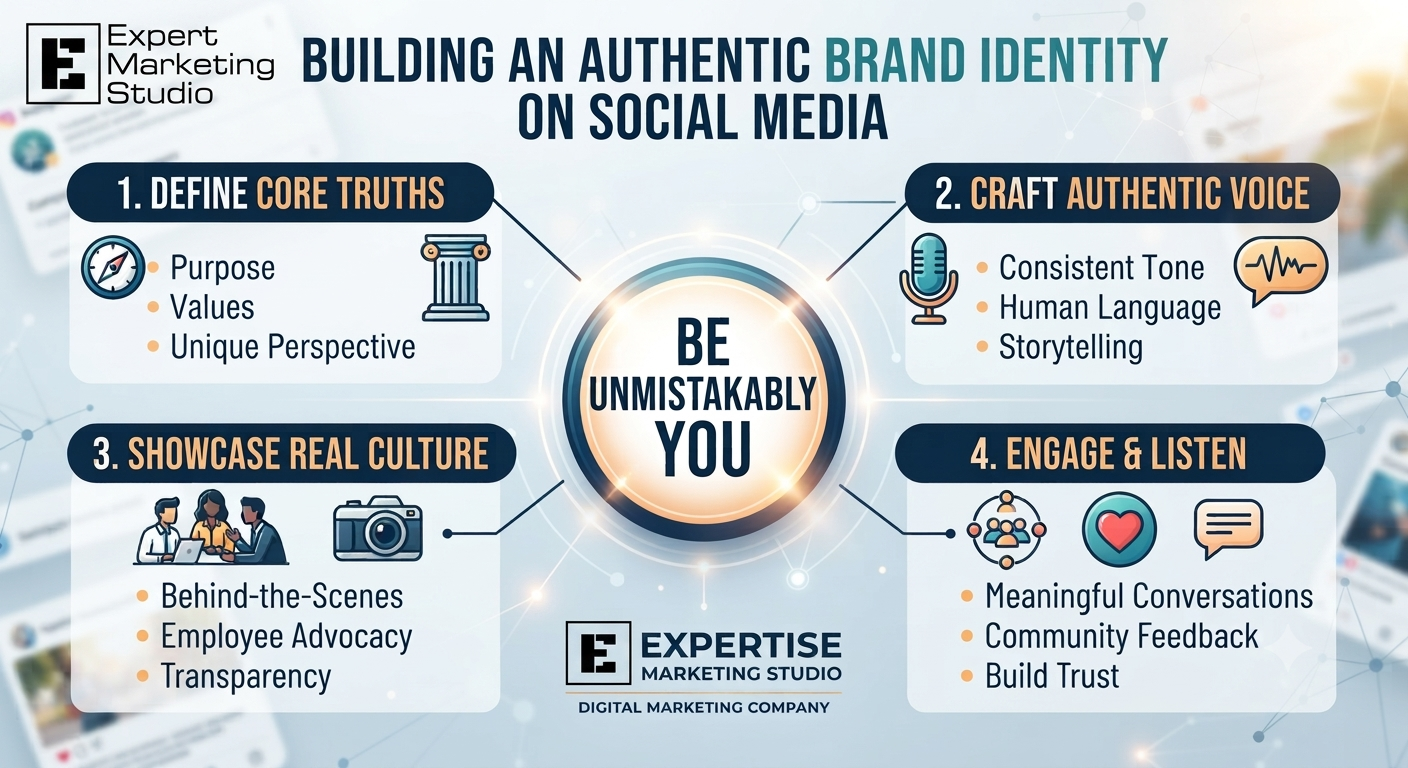
How to Build an Authentic Brand Identity on Social Media
Scroll through any major social feed for sixty seconds today and a pattern jumps out immediately: everything looks impeccably lit, grammatically flawless, hyper-optimized—and completely forgettable.
For years, the prevailing playbook in digital marketing equated professionalism with polish. Brands poured budgets into studio-grade photography, tightly scripted corporate videos, rigid grid aesthetics, and sterile, committee-approved captions. That formula worked when social media was a novel broadcast channel. It fails spectacularly in an era saturated with synthetic content, templated hooks, and automated engagement.
Modern audiences have developed acute “gloss blindness.” Confronted daily with AI-generated copy, airbrushed lifestyles, and brands jumping onto every fleeting trend without conviction, consumers instinctively filter out anything that feels manufactured. What stops the scroll now is not perfection—it is recognition. People stop when they encounter a distinct point of view, a real human face, an honest admission of trade-offs, or a brand that clearly knows who it is and who it serves.
At Expert Marketing Studio, we work with ambitious companies navigating this exact inflection point. Time and again,we see businesses confuse visibility with brand equity, or mistake posting frequently for building trust.
An authentic brand identity on social media is neither a happy accident nor a license to post aimlessly without strategy. It is a deliberate, disciplined alignment between what your organization genuinely believes, how you operate behind closed doors, and how you show up in public feeds every single day.
This guide breaks down the exact strategic framework we use to help brands strip away corporate veneer, define an unmistakable voice, navigate AI responsibly, and convert passive scrollers into fiercely loyal advocates.
Why Brand Authenticity Is the Ultimate Competitive Moat
Before diving into tactical execution, it is worth examining why authenticity has shifted from a “nice-to-have” brand attribute to a hard commercial driver. Three structural shifts in the digital landscape have made genuine identity indispensable:
1. Consumer Skepticism Toward Synthetic Media
Generative AI has collapsed the cost of producing passable content to near zero. As a result, feeds are flooded with derivative carousels, stock-style visuals, and formulaic thought leadership.
Consumer research underscores the backlash: nearly a third of consumers report being less likely to choose a brand that relies on AI-generated ads, and audiences increasingly gravitate toward raw, human-made storytelling over overly edited productions. When anyone can generate a sleek post in ten seconds, human judgment, lived experience, and verifiable proof become scarce—and therefore valuable.
2. Algorithmic Evolution Toward Depth Over Reach
Social algorithms no longer reward passive vanity metrics the way they once did. Across LinkedIn, Instagram, TikTok,and YouTube, distribution engines prioritize high-intent signals: saves, shares via direct message, meaningful comment threads, watch-time retention, and social search queries.
You cannot hack a DM share with clickbait; people share content privately with colleagues and friends only when it resonates deeply, solves a real problem, or articulates an insight they wish they had written themselves.
3. The Collapse of the Funnel into Social Ecosystems
Discovery, evaluation, and purchasing increasingly happen inside social platforms without users ever clicking out to a traditional website. Buyers search Instagram, TikTok, and LinkedIn like search engines to vet a company’s culture, read real customer commentary, and see how founders handle tough questions.
Your social presence is your storefront, your customer service desk, and your reputation ledger rolled into one.
Core Principle: Authenticity is not about revealing every internal secret or adopting a casual, meme-heavy tone regardless of your industry. Authenticity is congruence—ensuring that your external messaging matches your internal reality.
Phase 1: Excavating Your Brand’s Core Truth
You cannot project an authentic identity on social media if your leadership team cannot articulate what makes your company genuinely different in a single plain-English paragraph. Most social media strategies fail in week three because they begin with content calendars instead of identity excavation.
At Expert Marketing Studio, we start every brand identity engagement by auditing three foundational pillars before designing a single post.
1. Define Your Non-Negotiable Brand Pillars
Strip away industry buzzwords like “innovative,” “customer-centric,” or “best-in-class”—words every competitor claims and no buyer believes. Instead, anchor your identity in three concrete truths:
- Purpose (Why You Exist Beyond Margin): What problem irritated your founders enough to build this company?What broken norm in your industry are you actively trying to fix?
- Perspective (What You Believe That Competitors Disagree With): Every memorable brand holds a clear point of view. A cybersecurity firm might argue that compliance checklists create a false sense of security; a skincare brand might champion three-ingredient minimalism over twelve-step routines. If your stance never challenges conventional wisdom, your content will blend into background noise.
- Promise (The Standard You Refuse to Compromise): What can a customer count on every single time they interact with you, even when it costs you extra time or margin?
2. Identify Your “Only-We” Differentiators
Ask your team: What stories, data points, workflows, or lessons can only we share?
- If you are a B2B SaaS company, your “only-we” assets might be anonymized usage benchmarks from 5,000 customer workspaces or candid engineering post-mortems.
- If you are a specialty coffee roaster, it might be direct-trade farm visits, roast-curve experiments that failed, and exact transparency on farmer payouts.
- If you are a boutique consultancy, it might be the actual decision frameworks your strategists use on client calls.
When your content draws directly from proprietary experience rather than recycled internet summaries, competitors cannot copy it—even if they mimic your visual aesthetic.
3. Conduct a Brutal Perception Gap Audit
Before reinventing your social presence, measure the distance between how you think you sound and how customers actually experience you. Pull your last 50 social posts alongside your last 50 customer support tickets, sales call transcripts, and third-party reviews.
- Do your posts sound warm and conversational while your support replies sound robotic and legalistic?
- Do you claim to champion simplicity while your social captions are dense with jargon?
- What exact phrases do your happiest customers use when describing why they hired or bought from you?
Those customer phrases are gold. Lifting real buyer language directly into your social messaging creates immediate psychological resonance.
Phase 2: Crafting a Human-First Verbal and Visual Identity
Once your strategic foundation is clear, translate it into a cohesive verbal and visual system. Note the word system, not straitjacket. The strongest modern brands pair unmistakable recognition with enough flexibility to feel alive across diverse formats.
Building a Practical Brand Voice Matrix
A generic instruction like “be friendly yet professional” is useless to a social media manager writing under deadline.Instead, build an actionable Brand Voice Matrix with four dimensions, defining what your brand is, what it is not, and how it sounds in practice:
| Voice Dimension | Who We Are | Who We Are NOT (Guardrails) | Example in a Social Caption |
|---|---|---|---|
| Authority | Experienced practitioner sharing hard-won lessons | Ivory-tower lecturer or hype-driven guru | “We tested 14 onboarding flows last quarter. Eleven tanked activation. Here are the three that worked.” |
| Warmth | Generous, grounded peer cheering the reader on | Overly familiar, gimmicky, or sycophantic | “If your Q3 pipeline feels sluggish, you’re not alone—let’s walk through a quick diagnostic.” |
| Candor | Direct, transparent about trade-offs and limits | Cynical, abrasive, or unnecessarily blunt | “Our platform isn’t built for solo freelancers. If you have a team of 15+, though, it will save you 12 hours a week.” |
| Wit | Dry, observant, culturally aware | Forced meme-chasing or sarcastic at the customer’s expense | “Another ‘revolutionary’ AI wrapper just launched. Meanwhile, your customers still just want someone to answer their email.” |
Adapting Tone Without Losing Identity
Your voice stays constant; your tone flexes to fit the platform and emotional context. Think of how a real person speaks:you have the same personality at a keynote conference, a coffee shop brainstorm, and a customer apology call, yet your register shifts naturally in each room.
- LinkedIn: Analytical, structured, narrative-driven, comfortable with nuance and industry specifics.
- Instagram & TikTok: Visual-first, punchier hooks, behind-the-scenes immediacy, conversational cadence.
- YouTube: Deep-dive educational clarity, unhurried storytelling, high-context demonstrations.
- Community Replies & DMs: Unscripted, empathetic, fast, zero corporate boilerplate.
Evolving from Rigid Templates to Adaptive Visual Systems
Visual branding on social media has undergone a major shift. The era of hyper-curated, pastel-coordinated Instagram grids where every third tile had to be a quote graphic is dead. Today’s audiences associate over-engineered templates with ads—and swipe right past them.
Instead, design an adaptive visual identity rooted in sensory texture and real human presence:
- Prioritize Real Environments Over Stock Perfection: Natural daylight, messy whiteboards, warehouse floors,team huddle rooms, and handheld smartphone footage signal truth in ways studio lighting never can.
- Establish Consistent Visual Anchors, Not Identical Layouts: Keep typography, core color moods, and logo usage disciplined so your brand is recognizable within half a second, while allowing photography and video framing to breathe naturally.
- Design for Sound-Off and Sound-On: Pair crisp, legible kinetic captions and editorial typography with authentic human voiceovers—never generic text-to-speech narration when a team member can speak directly to the camera.
Performative Branding vs. Authentic Brand Identity
To keep your team aligned during content reviews, use this diagnostic comparison:
| Strategic Area | Performative Branding (What Audiences Tune Out) | Authentic Brand Identity (What Builds Trust & Revenue) |
|---|---|---|
| Content Origin | Chasing trending audio or viral formats unrelated to your niche | Documenting real customer problems, internal debates, and proven workflows |
| Visual Aesthetic | Stock photography, hyper-retouched graphics, rigid templates | Candid photography, lo-fi vertical video, recognizable typography & color mood |
| Messaging Focus | Self-congratulatory announcements, feature lists, constant promos | Practical education, honest trade-offs, customer transformation stories |
| Leadership Presence | Ghostwritten corporate platitudes posted once a month | Founders and specialists sharing unfiltered takes and replying to comments |
| Handling Mistakes | Deleting negative comments or issuing vague PR non-apologies | Publicly acknowledging friction, explaining the fix, and following up |
| Primary Metric | Follower count and raw impressions | Saves, DM shares, sentiment quality, branded search, and pipeline influence |
Phase 3: Navigating the AI Paradox Without Losing Your Soul
Every marketing team today uses artificial intelligence—and they should. AI is extraordinary for pattern analysis, audience research, transcribing raw voice notes, testing headline variations, and repurposing long-form webinars into multi-platform drafts.
The trap lies in allowing AI to become your public voice. Large language models are statistical averages of the internet; by definition, unedited AI copy regresses toward the median. If you feed a prompt into an LLM and publish the output straight to LinkedIn or Instagram, you are voluntarily sounding like every other company using the exact same model.
At Expert Marketing Studio, we enforce a strict “AI Backstage, Humans Onstage” rule:
- Use AI for Synthesis and Structure: Feed AI transcripts of your founder’s voice memos, customer interviews, and sales calls to extract recurring objections and outline content clusters.
- Keep Humans on Hooks, Stories, and Opinions: A human strategist or subject-matter expert must write the opening hook, inject specific real-world anecdotes, and sharpen the final point of view.
- Preserve Productive Imperfection: Resist the urge to sand down every rough edge. A slight pause in a founder’s video, an unscripted laugh during a product demo, or a hand-sketched diagram on an iPad communicates unmistakably that a real human made this.
- Be Transparent When AI Is Part of the Creative: If you use generative visuals for a conceptual campaign or an AI tool in your workflow, label it openly. Transparency reinforces credibility; concealment destroys it the moment audiences notice.
Phase 4: Content Pillars That Build Deep Trust and Authority
An authentic identity comes to life through consistent, repeatable programming. Rather than staring at a blank calendar every Monday wondering what to post, organize your editorial strategy around four high-trust content pillars, governed by the 80/20 Value-to-Promotion Rule—where at least 80% of your output educates, entertains, or solves a problem before you ever ask for a click or a sale.
Pillar 1: Radical Transparency & “Build in Public” Documentation
People trust processes they can see. Instead of announcing only finished milestones, invite your audience inside the workshop:
- Show the Craft: Walk through how your product is formulated, how your creative team critiques a campaign, or how you vet suppliers.
- Share Lessons from Failure: Post a candid breakdown of a launch that underperformed, what your team misjudged, and what you changed next. Counterintuitively, admitting a flaw makes every positive claim you make afterward ten times more believable.
- Demystify Pricing and Decisions: Explain why your service costs what it does, what goes into the scope, and how buyers should evaluate vendors—even if they don’t choose you.
Pillar 2: Point-of-View (POV) Thought Leadership
Informational “how-to” tips are easily commoditized by search engines and AI summaries. Perspective is not. Dedicate a core pillar to sharp, experience-backed commentary on your industry:
- Challenge outdated best practices that waste your customers’ money.
- React rapidly to breaking industry news with clear “what this actually means for you” analysis.
- Publish original micro-research, customer benchmarks, or teardown audits that give your audience proprietary insight they cannot get elsewhere.
Pillar 3: Employee Advocacy & Humanizing the Team
Buyers rarely form emotional bonds with corporate logos; they bond with people. One of the highest-leverage moves in modern social marketing is empowering your internal experts—engineers, designers, strategists, customer success leads—to show up as recognizable faces of the brand.
- Feature short, unscripted “day-in-the-life” or “problem I solved this week” clips from real team members rather than actors.
- Support founder-led and employee-led personal profiles alongside your company page. Individual profiles consistently earn stronger organic distribution and higher reply rates than brand handles because people prefer talking to humans.
- Provide light editorial guardrails and storytelling prompts rather than forcing employees to copy-paste canned corporate blurbs—which audiences spot immediately.
Pillar 4: Community Co-Creation & User-Generated Content (UGC)
The most credible things said about your brand are never said by you—they are said by your customers.
- Turn Customer Wins into Hero Stories: Spotlight how real clients use your product in messy, real-world scenarios, crediting them prominently.
- Co-Create with Your Audience: Run polls to decide your next product feature, invite followers to submit questions for live Q&As, or co-host discussions with niche creators whose values genuinely mirror yours.
- Prioritize Micro-Creators Over Celebrity Reach: When partnering with creators, choose voices who already love your category and give them creative freedom to speak in their natural idiom rather than handing them a rigid script.
Phase 5: Turning Followers into Advocates Through Community Architecture
Publishing great content and logging off is like hosting a dinner party, setting food on the table, and locking yourself in the kitchen. Social media is a two-way conversational medium—and the magic happens in the spaces between posts.
Treat Comments and DMs as Your Primary Engine
High-performing brands dedicate as much discipline to community engagement as they do to content production:
- Reply Fast and Substantively: During the first 60 minutes after publishing, treat your comment section like a live conversation. Ask follow-up questions instead of dropping generic “Thanks for sharing!” emojis.
- Engage Outbound in Your Niche: Spend 15 minutes daily leaving thoughtful, non-promotional insights on posts by customers, partners, and industry peers. Becoming a familiar, helpful presence in your ecosystem builds organic recognition faster than cold outreach.
- Bridge Public Threads to Private DMs: When someone asks a nuanced question in the comments, answer the core point publicly so everyone benefits, then follow up in DMs with a tailored resource—never an aggressive sales pitch.
Handle Criticism Gracefully in Public
How a brand behaves under pressure reveals its true character. When a customer leaves a frustrated comment or points out a legitimate flaw:
- Never delete valid criticism (reserve moderation strictly for spam, hate speech, or harassment). Deleting real complaints signals insecurity and escalates backlash.
- Respond publicly with empathy and ownership: Acknowledge the issue without defensiveness, outline the immediate next step, and invite them to DM their order or account details so your team can resolve it fast.
- Close the loop: Once resolved, customers frequently update their original comment—turning a public complaint into third-party proof of your integrity.
Build Owned Off-Platform Anchors
Social algorithms are rented land; reach rules can shift overnight. Use your social authenticity to invite your most engaged followers into owned channels—an editorial newsletter, a private customer community, a podcast, or live workshops.When followers willingly hand over their email address because they trust your voice, you build a durable asset immune to feed volatility.
Phase 6: Measuring What Matters—KPIs for Brand Authenticity
If you measure an authenticity strategy using outdated vanity metrics, leadership will panic the moment a high-trust deep-dive post gets fewer raw impressions than a shallow viral meme. Align your reporting around metrics that reflect depth of resonance, trust, and commercial intent:
| Metric | What It Actually Measures | Why It Signals Authenticity |
|---|---|---|
| Save-to-Reach Ratio | Utility and long-term reference value | People bookmark posts they genuinely plan to apply or revisit |
| Share Rate (Especially DM Shares) | Cultural and interpersonal resonance | Audiences stake their personal reputation when sharing your content privately |
| Comment Depth & Sentiment | Conversational trust and emotional alignment | Substantive dialogue and positive sentiment prove your voice sparks real connection |
| Unprompted UGC & Brand Mentions | Organic advocacy and community ownership | Customers voluntarily weaving your brand into their own stories |
| Branded Search & Direct Traffic Lift | Off-platform memory and demand creation | Followers remember your name and actively seek you out days later |
| DM-to-Pipeline / Revenue Attribution | Commercial trust | Buyers feel confident initiating high-intent conversations directly in-app |
Pair quantitative dashboards with qualitative monthly listening: screenshot the ten best comments, DMs, or sales-call remarks mentioning your social content each month. Reviewing actual human feedback keeps your executive team grounded in what resonates.
A 90-Day Roadmap to Rebuilding Your Social Brand Identity
Transforming a generic social presence into a magnetic, authentic brand does not require pausing your marketing for six months. Follow this structured 90-day sprint:
1–30 Days: Audit, Excavate, and Align
- Conduct the Perception Gap Audit across your last 50 posts, reviews, and sales calls.
- Define your three non-negotiable brand pillars and “Only-We” differentiators.
- Build your Brand Voice Matrix and adaptive visual guidelines, retiring sterile stock templates.
- Optimize all social bios with plain-language clarity and natural keywords so buyers and social search engines immediately understand who you help and how.
31–60 Days: Launch Pilot Formats and Humanize Your Channels
- Roll out content across your four core pillars—introducing at least two recurring human-led series (e.g., founder takeaways, behind-the-scenes teardowns, or specialist Q&As).
- Activate 3 to 5 internal subject-matter experts or founders with light editorial support so real faces anchor your narrative.
- Institute a daily 20-minute outbound and inbound community engagement habit.
61–90 Days: Amplify Community Proof and Refine
- Spotlight early customer stories, UGC, and community questions to reinforce social proof.
- Review 60-day performance through the lens of saves, shares, DM conversations, and qualitative sentimentrather than raw likes alone.
- Double down on the formats that sparked the deepest conversations and retire anything that felt forced.
Final Thoughts: Authenticity Is Earned Daily
Building an authentic brand identity on social media is not a one-time rebrand or a clever copywriting trick. It is the cumulative result of showing up consistently with a clear point of view, telling the truth about your craft, putting real humans in front of the camera, and treating your audience like intelligent peers rather than impression statistics.
In a digital ecosystem increasingly crowded with automated noise, being unmistakably, verifiably human is your sharpest strategic advantage.
Ready to Build a Social Brand Identity That Actually Converts?
At Expert Marketing Studio, we help ambitious brands clarify their positioning, craft unmistakable verbal and visual identities, and execute human-first social media strategies that build lasting trust and measurable revenue.
Reach out to Expert Marketing Studio today to schedule a comprehensive Social Brand & Content Audit—and let’s turn your social presence into your strongest growth engine.