
Essential Data Privacy Regulations Every Marketer Should Know
Published by Expert Marketing Studio | Digital Marketing Strategy & Compliance Series
Introduction: The New Reality of Performance Marketing
For more than a decade, digital marketing operated on a simple, frictionless premise: collect as much user data as possible, stitch it together across third-party brokers, track users relentlessly across the open web, and optimize campaigns using opaque algorithmic targeting. That era is over.
Today, over 170 countries have enacted comprehensive data privacy laws, fundamentally altering how marketers acquire, nurture, measure, and retain customers. Regulatory enforcement is no longer a distant theoretical risk handled quietly by legal departments—it is an active operational constraint that directly affects ad account eligibility, attribution modeling, email deliverability, and customer acquisition costs.
At Expert Marketing Studio, we view data privacy not as a bureaucratic hurdle, but as the foundation of sustainable, high-converting marketing. When 40% to 60% of website visitors reject non-essential tracking cookies, brands that rely on legacy tracking architectures fly blind. Conversely, brands that embed privacy-by-design into their marketing technology stacks build higher customer trust, maintain cleaner first-party data, and achieve superior return on ad spend (ROAS).
This comprehensive guide breaks down the essential data privacy regulations every modern marketer must understand, how they affect day-to-day campaign execution, and the exact technical and strategic playbook required to turn compliance into a competitive advantage.
1. Why Data Privacy Is Now a Core Marketing Competency
Historically, marketing teams treated compliance as a post-campaign checklist—slapping a generic privacy policy link in a website footer and assuming legal teams handled the rest. That siloed approach fails in modern digital ecosystems for three structural reasons:
- Platform-Level Enforcement: Ad networks and browser vendors now enforce privacy laws directly through code. Google’s enforcement of Consent Mode v2, Apple’s App Tracking Transparency (ATT), and Meta’s Conversions API (CAPI) restrictions mean that non-compliant data collection results in degraded conversion tracking, broken remarketing audiences, and suspended ad accounts.
- Extraterritorial Reach: Modern privacy laws follow the consumer, not the company’s headquarters. A B2B SaaS firm in Austin, an e-commerce store in London, or a digital agency in New Delhi is legally bound by the privacy laws of every jurisdiction where its website visitors and subscribers reside.
- The Trust Dividend: Consumers are increasingly privacy-literate. Research consistently shows that roughly 90% of global consumers factor data protection practices into their purchasing decisions. Transparent value exchanges—where users understand why their data is requested and what they receive in return—produce higher engagement rates and lower churn than covert data harvesting.
Key Takeaway for Marketers: Privacy compliance is no longer just about avoiding multi-million-dollar regulatory fines; it is about preserving signal integrity in your analytics and ad platforms while earning durable brand equity.
2. The Big Four Global Data Privacy Frameworks
While navigating over a hundred national and regional statutes sounds daunting, most global privacy legislation clusters around four foundational frameworks. Mastering these four gives your marketing team a baseline architecture capable of scaling worldwide.
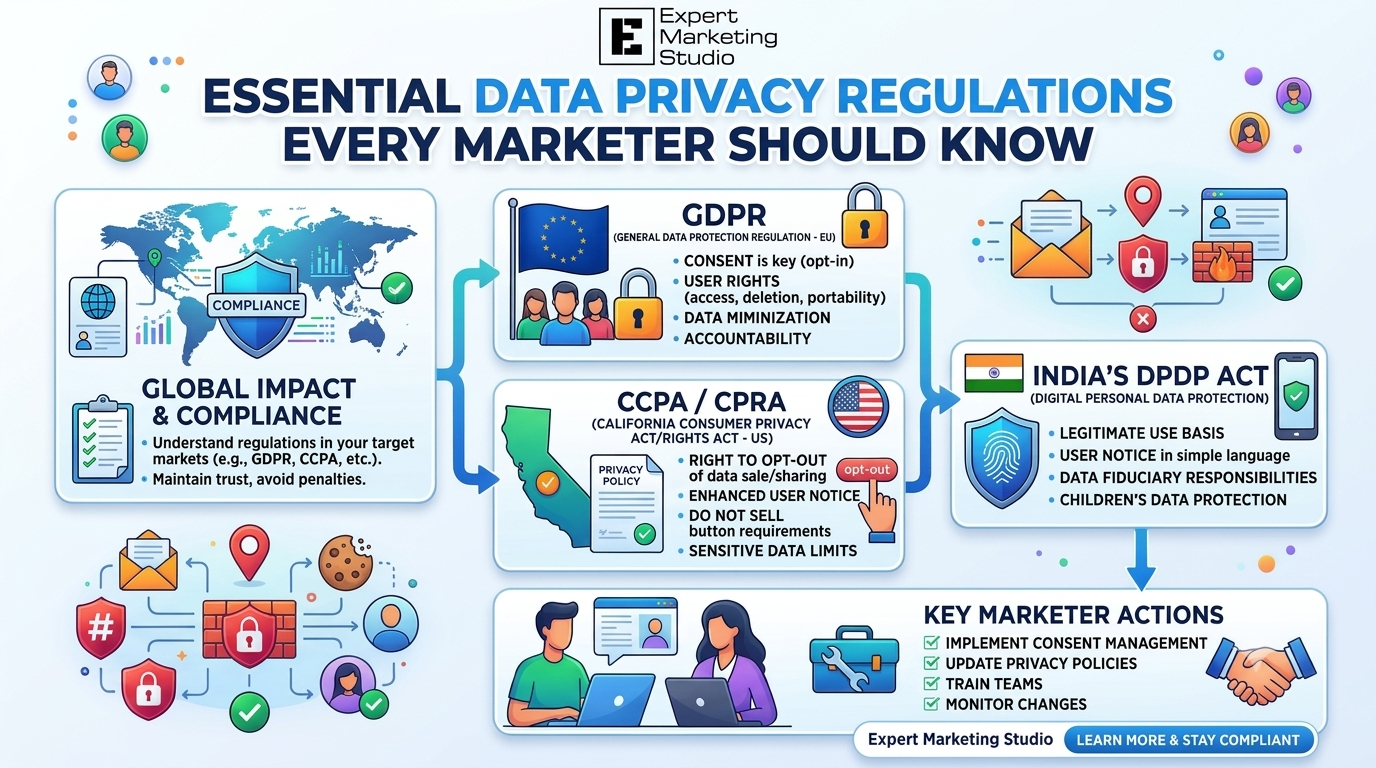
A. The General Data Protection Regulation (GDPR) — European Union & UK
Enacted in 2018 (and mirrored in the UK post-Brexit alongside the Privacy and Electronic Communications Regulations, or PECR, and the UK Data Use and Access Act 2025), the GDPR remains the global gold standard for data protection.
Who It Applies To: Any organization worldwide that processes the personal data of individuals located in the European Economic Area (EEA) or the UK, regardless of whether the company has a physical presence there.
What Counts as Personal Data: Under GDPR, personal data encompasses any identifier that can directly or indirectly pinpoint an individual. For marketers, this explicitly includes names, email addresses, phone numbers, IP addresses, mobile advertising IDs (IDFAs/GAIDs), and browser cookies.
Core Rules for Marketers:
- Six Lawful Bases for Processing: You cannot collect or process data without a documented legal justification. In marketing, the two primary bases are Explicit Consent (required for non-essential cookies, cold email/SMS outreach to prospects, and sensitive data) and Legitimate Interest (occasionally permissible for soft opt-in marketing to existing customers, though increasingly scrutinized in behavioral advertising).
- Strict Standards for Valid Consent: Consent must be freely given, specific, informed, and unambiguous. Pre-ticked checkboxes, bundled consent (forcing users to accept marketing emails to download a whitepaper), and “cookie walls” that block site access unless tracking is accepted are illegal.
- The Six Data Protection Principles: Marketers must adhere to lawfulness/transparency, purpose limitation (you cannot collect an email for a webinar and secretly add it to a cold sales sequence), data minimization (only ask for fields you genuinely need), accuracy, storage limitation, and security.
- Individual Rights & The 30-Day Clock: Users have the right to access, rectify, port, or erase their data (“Right to be Forgotten”). When a user submits a deletion request, your team has 30 days to scrub their record not just from your primary CRM, but also from email tools, ad platform custom audiences, analytics exports, and third-party subprocessors.
Penalties: Up to €20 million or 4% of global annual turnover, whichever is higher.
B. The California Consumer Privacy Act & California Privacy Rights Act (CCPA / CPRA)
California’s privacy regime—originally passed as the CCPA and substantially expanded by the CPRA—sets the de facto benchmark for consumer privacy in the United States.
Who It Applies To: For-profit businesses doing business in California that meet at least one of three thresholds:
- Gross annual revenue exceeding $25 million (periodically adjusted for inflation).
- Buying, selling, or sharing the personal information of 100,000 or more California consumers or households annually.
- Deriving 50% or more of annual revenue from selling or sharing California consumers’ personal information.
The Opt-Out Model vs. GDPR’s Opt-In Model: Unlike the GDPR, which requires proactive opt-in permission before firing tracking pixels, the CCPA/CPRA largely operates on an opt-out model for adults. Businesses may collect data upon notice, provided they give consumers an immediate, frictionless mechanism to opt out.
Core Rules for Marketers:
- “Sale” vs. “Sharing” for Cross-Context Behavioral Advertising: Under CPRA, transmitting personal data (including cookie IDs and hashed emails) to ad networks like Meta, Google, or TikTok for retargeting constitutes “sharing” for cross-context behavioral advertising—even if no money changes hands.
- Mandatory “Do Not Sell or Share My Personal Information” Link: Websites targeting California residents must display a clear, conspicuous opt-out link in their footer (or a unified “Your Privacy Choices” icon) that immediately halts data transmission to ad tech partners.
- Global Privacy Control (GPC) Signals: California law legally requires websites to recognize and honor browser-based opt-out signals (such as Global Privacy Control). If a user visits your landing page with GPC enabled in their browser, your tag manager must automatically suppress ad-sharing pixels without requiring the user to click a banner.
- Sensitive Personal Information (SPI): Consumers can limit the use of SPI—which includes precise geolocation, racial/ethnic origin, health data, and account login credentials—strictly to what is necessary to deliver the requested service.
Penalties: CPI-adjusted administrative fines exceeding $2,663 per unintentional violation and $7,988 per intentional violation (or violations involving minors under 16), assessed per affected consumer—meaning a single misconfigured pixel across 10,000 visitors can trigger tens of millions in statutory exposure.
C. India’s Digital Personal Data Protection (DPDP) Act & Rules
As one of the world’s largest and fastest-growing digital consumer markets, India’s Digital Personal Data Protection (DPDP) Act, operationalized through the notified DPDP Rules with phased enforcement milestones running through May 2027, reshapes digital marketing across South Asia and for global brands serving Indian users.
Who It Applies To: Any organization processing digital personal data within India, as well as foreign entities outside India offering goods or services to individuals (“Data Principals”) inside India. Crucially, unlike the CCPA, the DPDP Act includes no revenue or user-count exemptions for small businesses or startups.
Core Rules for Marketers:
- Itemized, Plain-Language Consent Notices: Before or at the moment of data collection, marketers (“Data Fiduciaries”) must present a standalone, plain-language notice detailing exactly what personal data is being collected, the specific purpose for each data point, and how the user can withdraw consent or file a grievance. Notices must be available in English and all 22 scheduled Indian languages.
- One-Click Consent Withdrawal & Consent Managers: Withdrawing consent must be just as easy as granting it. Furthermore, India has introduced a regulated ecosystem of Consent Managers—registered digital platforms through which Indian consumers can centrally view, manage, and revoke permissions across brands via standardized APIs.
- Strict Prohibition on Tracking Minors: Under the DPDP Act, anyone under the age of 18 is classified as a child. Marketers must obtain verifiable parental consent before processing a minor’s data, and behavioral tracking, profiling, and targeted advertising aimed at under-18 users are strictly prohibited—even with parental consent.
- Automated Retention & Pre-Deletion Alerts: Personal data cannot be kept indefinitely “just in case”. Once a campaign or service purpose is fulfilled (or if a user remains inactive past a defined statutory period), data must be purged, with advance notice sent to the user 48 hours prior to automated erasure.
Penalties: Up to ₹250 crore (approx. $30 million USD) for failure to maintain reasonable security safeguards preventing a data breach, and up to ₹200 crore for violations involving children’s data or breach notification failures.
D. The Expanding U.S. State Privacy Patchwork & Canada’s PIPEDAIAPP
Beyond California, over a dozen U.S. states—including Virginia (VCDPA), Colorado (CPA), Connecticut (CTDPA), Texas (TDPSA), Oregon, Montana, Florida, and Delaware—enforce comprehensive consumer privacy statutes. While most follow the “Virginia baseline model” (granting rights to access, delete, and opt out of targeted advertising and data sales), states like Colorado and Connecticut mandate universal opt-out mechanism recognition, and Texas’s TDPSA applies broadly to nearly any business that is not classified as a small business by the U.S. Small Business Administration (SBA), regardless of revenue thresholds.
Meanwhile, in Canada, the Personal Information Protection and Electronic Documents Act (PIPEDA) alongside provincial laws like Quebec’s Law 25 enforce strict consent rules. Quebec’s Law 25, in particular, closely mirrors the GDPR—requiring explicit opt-in consent before activating profiling, geolocation, or behavioral tracking cookies, and mandating the publication of clear governance policies and Privacy Impact Assessments (PIAs).
3. Comparative Matrix: Global Privacy Rules at a Glance
To help marketing leaders and operations teams align campaign workflows across regions, the table below compares core compliance requirements across major jurisdictions:
| Compliance Dimension | EU / UK (GDPR & PECR) | California (CCPA / CPRA) | India (DPDP Act & Rules) | Canada (PIPEDA & Law 25) |
|---|---|---|---|---|
| Default Tracking Model | Strict Opt-In: Block all non-essential cookies/pixels until affirmative consent. | Opt-Out: Allowed upon notice unless user opts out or sends GPC signal. | Strict Opt-In: Itemized, purpose-specific affirmative consent required. | Opt-In for sensitive data & behavioral tracking (strict under Law 25). |
| Email & SMS Marketing | Explicit opt-in required (soft opt-in limited to existing customers). | Notice + easy unsubscribe (governed alongside federal CAN-SPAM / TCPA). | Explicit, unbundled consent required for promotional outreach. | Explicit or documented implied consent required (governed alongside CASL). |
| Retargeting & Ad Tech | Requires granular advertising cookie consent before firing pixels. | Must honor “Do Not Sell or Share” links & browser GPC signals. | Permitted only with explicit, purpose-bound consent; banned for under-18s. | Consent required before activating cross-site profiling technologies. |
| Age of Minor Protection | Under 16 (member states may lower to 13). | Under 16 (opt-in required to sell/share data; under 13 requires parental consent). | Under 18 (verifiable parental consent; total ban on targeted ads). | Under 14 (under Quebec Law 25). |
| DSAR / Deletion Window | 30 days (extendable by 60 days for complex requests). | 45 days (extendable once by 45 days with notice). | 30 days (via Data Fiduciary or registered Consent Manager). | 30 days. |
| Maximum Penalties | €20M or 4% of global annual revenue. | $2,663 – $7,988 per violation (compounding per consumer). | Up to ₹250 crore (~$30M USD) per breach/violation category. | Up to $100,000 CAD (PIPEDA) / $25M CAD or 4% revenue (Law 25). |
4. Channel-Specific Regulations Marketers Often Overlook
Comprehensive privacy laws set the overarching rules, but channel-specific statutes frequently catch performance marketers off guard. Even if your website has a compliant cookie banner, violating channel rules can result in carrier blacklisting, ISP spam filtering, or statutory class-action lawsuits.
Email Marketing: CAN-SPAM, CASL, and GDPR
- United States (CAN-SPAM Act): Operates on an opt-out framework for commercial email, meaning you can send cold B2B or B2C emails without prior consent provided you include accurate header routing information, non-deceptive subject lines, a valid physical postal address, and a clear unsubscribe mechanism that must be honored within 10 business days.
- Canada (CASL): One of the strictest anti-spam laws globally. Unlike CAN-SPAM, CASL requires prior express or documented implied consent before sending a commercial electronic message to a Canadian inbox. Every email must identify the sender, provide contact details, and include a working unsubscribe mechanism that processes requests immediately (and no later than 10 business days).
- Best Practice: Standardize your global email acquisition forms around the highest common denominator—double opt-in with an unchecked consent box and a clear description of email frequency. Maintain a permanent suppression list of unsubscribed email hashes rather than deleting them outright, ensuring you never accidentally re-upload an opted-out contact during CRM syncs.
SMS & WhatsApp Marketing: TCPA and Carrier Mandates
Text messaging boasts open rates above 90%, making it a prime target for regulators and telecom carriers.
- United States (TCPA): Under the Telephone Consumer Protection Act, sending automated marketing SMS or MMS messages requires Prior Express Written Consent (PEWC). Simply collecting a phone number during e-commerce checkout does not authorize promotional texting.
- Disclosure Requirements: Your opt-in form must feature an unchecked box accompanied by clear language stating that the user agrees to receive recurring automated marketing texts at the number provided, that consent is not a condition of purchase, and linking to your Terms and Privacy Policy. Every campaign must automatically recognize
STOP,END, andUNSUBSCRIBEkeywords and log timestamped proof of consent.
Children’s Privacy: COPPA & Global Youth Protections
If your brand operates in gaming, education, entertainment, consumer snacks, or apparel that appeals to youth audiences, COPPA (the U.S. Children’s Online Privacy Protection Act, reinforced by modernized FTC rules) and India’s DPDP Act create severe legal exposure.
- You cannot rely on passive assumptions or simple “I am over 13” checkboxes if your site is directed toward children.
- Behavioral retargeting pixels must be completely suppressed on youth-directed pages, and any data collection from under-13 users (or under-18 in India) requires verifiable parental consent before a single byte of personal data hits your analytics or CRM servers.
5. How Privacy Laws Directly Impact Your MarTech Stack
Understanding legal theory is only half the battle; the real work happens inside your marketing technology stack. When privacy laws are misconfigured at the technical layer, marketers suffer from either illegal data leakage or catastrophic data loss.
1. Consent Management Platforms (CMPs) & Tag Firing
A Consent Management Platform (such as OneTrust, Cookiebot, Usercentrics, or Didomi) is the gatekeeper of yourwebsite. However, a common audit failure uncovered by agencies is premature tag firing—displaying a cookie banner while Google Analytics, Meta Pixel, LinkedIn Insight Tag, and TikTok pixels simultaneously fire in the background before the user clicks “Accept”.
- The Fix: Configure your CMP to integrate natively with Google Tag Manager (GTM) or your server-side tagging container. All advertising and analytics tags must remain blocked in a “default denied” state until the CMP passes an explicit consent signal.
- Avoid Dark Patterns: Regulators aggressively penalize manipulative banner designs—such as making the “Accept All” button bright green while hiding “Reject All” behind three layers of menus. Ensure “Accept” and “Reject” buttons carry equal visual weight on the first layer.
2. Google Consent Mode v2 & Privacy-Preserving Attribution
When 50% of European or privacy-conscious visitors decline cookies, standard conversion tracking breaks, starving ad bidding algorithms of conversion data. Google Consent Mode v2 solves this legally by communicating a user’s consent status (ad_storage, analytics_storage, ad_user_data, and ad_personalization) to Google tags.
- When a user declines cookies, Google tags do not read or write browser cookies; instead, they send cookieless pings containing non-identifying metadata (timestamp, user agent, referrer, and conversion event type).
- Google’s machine learning models then use these cookieless signals alongside consented conversion paths to recover up to 70% of lost conversion attribution without violating GDPR or DMA mandates.
3. Server-Side Tagging & First-Party Data Governance
Client-side tracking (loading dozens of third-party JavaScript snippets directly inside a user’s browser) exposes your site to data leakage, slow page speeds, and aggressive browser tracking prevention (like Safari’s ITP).
- Moving to server-side tagging routes analytics and conversion data through a secure first-party cloud server controlled by your brand before forwarding approved events to ad platforms.
- This architecture gives your marketing operations team granular control to strip out sensitive IP addresses, redact PII, and enforce user consent flags before any payload reaches Meta, Google, or third-party analytics tools.
4. CRM, CDP, and Customer Match Lists
Uploading a CSV of customer emails to Meta Custom Audiences or Google Customer Match is legally classified as data processing and sharing.
- You may only upload contacts who have consented to advertising use (under GDPR/DPDP) and have not opted out of data sharing (under CCPA/CPRA).OneTrust
- Manual CSV uploads are a major compliance liability because static spreadsheets become non-compliant the moment a user opts out on your website. Instead, connect your CRM or Customer Data Platform (CDP) directly to ad platforms via automated, bi-directional audience syncs so opt-outs propagate automatically within hours.
5. AI Marketing Tools & Data Leakage
Generative AI and predictive analytics tools have become staples in campaign production, copywriting, and customer segmentation. However, uploading raw customer lists, support transcripts, or proprietary CRM exports into public AI models creates immediate data-processing and cross-border transfer violations.
- Always use enterprise-tier AI workspaces with zero-data-retention guarantees and executed Data Processing Agreements (DPAs).
- Never train custom AI personalization models on personal data unless your privacy notice explicitly discloses automated profiling and your lawful basis covers it.
6. Ethical Optimization: How to Boost Opt-In Rates Without Breaking the Law
Compliance does not mean resigning your brand to zero data. At Expert Marketing Studio, we help clients optimize consent flows using transparent UX psychology that respects user autonomy while maximizing opt-in rates:
- Replace Legal Jargon with Clear Value Propositions: Generic banners reading “We use cookies to enhance your browsing experience” trigger automatic rejections. Testing plain-language, benefit-driven copy—such as “Help us tailor product recommendations and remember your cart preferences. You can adjust this anytime”—consistently lifts acceptance rates by 8% to 12%.
- Use Progressive & Contextual Consent: Rather than ambushing first-time visitors with a full-screen modal the millisecond a page loads, trigger non-intrusive banners after the user engages with your content (e.g., scrolling 40% through a guide or viewing a second page). Users who have already experienced value from your brand are significantly more willing to share data.
- Invest in Zero-Party Data Experiences: Zero-party data—information a customer intentionally and proactivelyshares with you—is 100% privacy-compliant, wildly accurate, and immune to cookie deprecation. Interactive product finders, diagnostic quizzes, preference centers, and post-purchase surveys give marketers rich segmentation attributes while delivering genuine utility to the buyer.
- Reclaim Contextual Advertising: Where behavioral retargeting is restricted by consent declines or youth protections, modern contextual targeting—placing ads alongside high-intent content using semantic AI rather than user surveillance—delivers comparable brand lift and conversion efficiency without touching personal identifiers.
7. The Marketer’s Actionable Privacy Compliance Checklist
Whether you manage an in-house growth team or oversee multi-client campaigns, implement this six-step governance workflow to audit and future-proof your marketing operations:
- Step 1: Conduct a Complete Data & Pixel Audit. Inventory every tracking script, form, webhook, CRM integration, and third-party vendor touching customer data. Remove legacy pixels from abandoned ad platforms (“shadow MarTech”) that silently siphon user data.
- Step 2: Verify CMP & Tag Manager Synchronization. Test your website in an incognito browser across desktop and mobile. Open your browser’s developer network tab before clicking anything on your cookie banner—if Google Analytics, Meta, or LinkedIn requests appear before consent is granted, your setup is non-compliant.
- Step 3: Standardize Unbundled Form Disclosures. Audit every lead-gen form, newsletter signup, and checkout flow. Separate Terms of Service acceptance from marketing communications opt-ins, remove pre-checked boxes, and log timestamped consent sources inside your CRM.
- Step 4: Automate DSAR & Suppression Workflows. Establish a documented workflow to fulfill Data Subject Access and Deletion Requests within 30 days across all connected tools, while maintaining encrypted suppression lists so unsubscribed users are never re-targeted.
- Step 5: Execute Data Processing Agreements (DPAs). Ensure signed DPAs are on file with every email service provider, CRM, analytics vendor, cloud host, and marketing agency handling your customer records.
- Step 6: Align Client-Agency Access Governance. If you partner with external agencies, maintain brand ownership over your ad accounts, pixels, and analytics properties—granting partner-level role access rather than sharing raw login credentials or transferring data ownership.
Conclusion: Turning Privacy Into Your Competitive Advantage
Data privacy regulations are no longer temporary storms to weather; they are the permanent climate of digital marketing. As GDPR enforcement matures, U.S. state laws multiply, and India’s DPDP framework reshapes one of the world’s largest digital economies, the gap between compliant, trust-first brands and legacy data-hoarders will continue to widen.
Marketers who embrace privacy-by-design gain far more than legal peace of mind. They build cleaner, higher-intent customer databases, unlock resilient server-side and modeled attribution, and forge authentic relationships with audiences tired of feeling tracked across the internet.
Need help auditing your MarTech stack, configuring Consent Mode v2, or building a high-converting first-party data strategy? Reach out to the strategy and analytics team at Expert Marketing Studio to ensure your campaigns are both fully compliant and engineered for scalable growth.