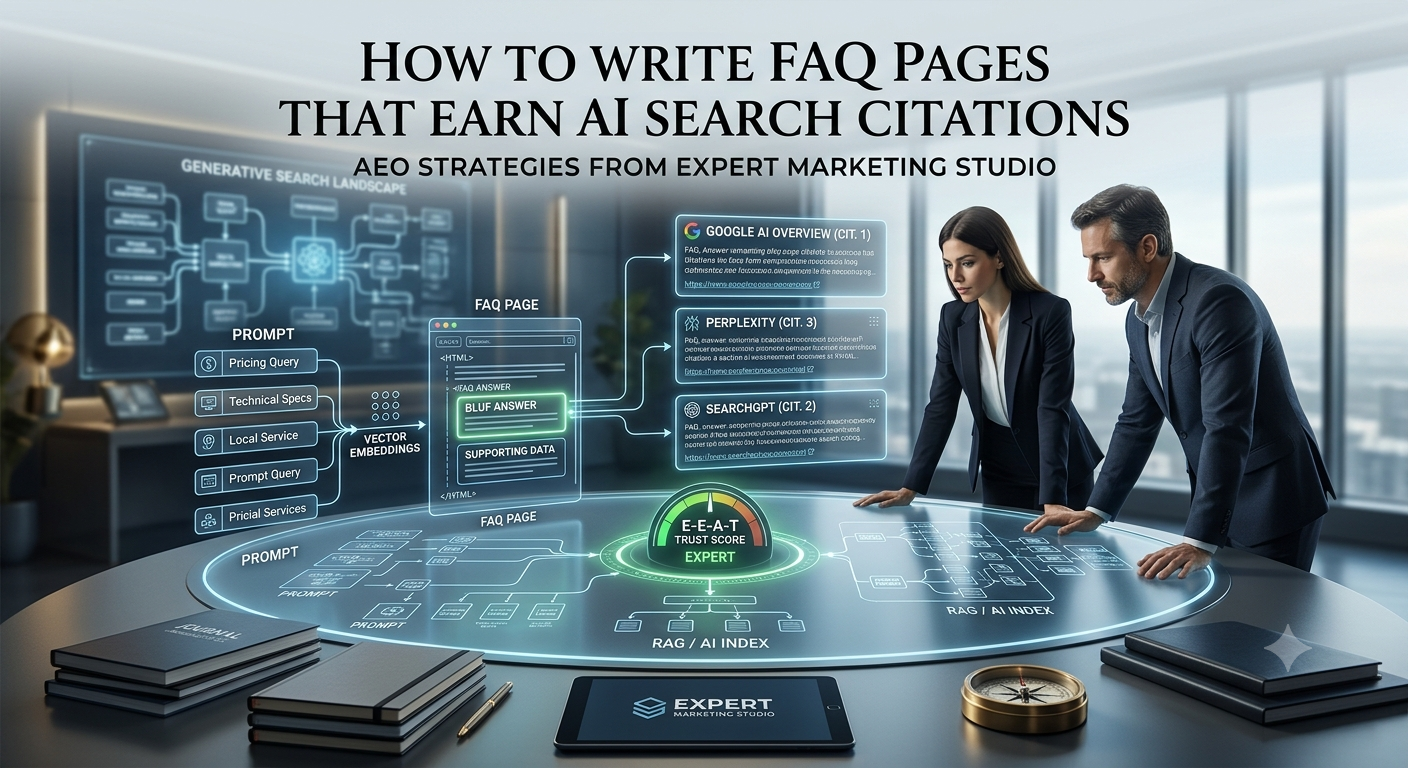
How to Write FAQ Pages That Earn AI Search Citations
How to Write FAQ Pages That Earn AI Search Citations
The search landscape has experienced its most profound shift since the invention of the hyperlink.
For nearly three decades, search engine optimization meant ranking ten blue links on Google. You targeted high-volume keywords, built backlinks, and optimized title tags to drive direct organic clicks. Today, Large Language Models (LLMs) and generative search engines—such as Google AI Overviews, Perplexity AI, ChatGPT Search, and Claude—are transforming how users acquire information.
AEOmotor
Searchers no longer scan ten blue links. They ask conversational, zero-click questions and receive real-time, synthetically compiled answers.
Limy.ai
If your company’s information isn’t cited inside those generated answers, your business effectively doesn’t exist to modern searchers.
At Expert Marketing Studio, we have spent months analyzing how Generative Engine Optimization (GEO) and Answer Engine Optimization (AEO) differ from traditional SEO. The takeaway is clear: the humble FAQ page has transformed into your highest-leverage asset for winning AI search citations.
Limy.ai
In this comprehensive guide, we unpack the mechanics of AI retrieval, explain why FAQ structures naturally win LLM citations, and provide a step-by-step framework to engineer FAQ pages that consistently get quoted by AI search engines.
AEOmotor
1. The Paradigm Shift: Traditional SEO vs. Answer Engine Optimization (AEO)
To write content that wins AI citations, you must understand how generative search engines process web pages differently than legacy web crawlers.
+-------------------------------------------------------------------+
|                        TRADITIONAL SEO                            |
| Target: Keyword Search Engine (Google Classic)                     |
| Mechanism: Crawls page -> Ranks keywords -> Serves blue links     |
| Goal: Drive user clicks to land on site                           |
+-------------------------------------------------------------------+
                                 │
                                 ▼
+-------------------------------------------------------------------+
|               ANSWER ENGINE OPTIMIZATION (AEO)                     |
| Target: Generative AI Engines (ChatGPT, Gemini, Perplexity)       |
| Mechanism: Extracts structured facts -> Synthesizes direct answer |
| Goal: Earn inline citations and brand recommendations              |
+-------------------------------------------------------------------+
Traditional SEO Mechanics
Legacy search engines match user keywords against indexed web documents using lexical algorithms (BM25) and link-graph authority signals (PageRank). The objective is to evaluate which page is most relevant to a query and return a list of clickable links.
AEO & GEO Mechanics
AI engines function as synthesis machines. When a user inputs a query, engines like Perplexity or Google Gemini follow a Retrieval-Augmented Generation (RAG) pipeline:
- Query Deconstruction: The AI expands the user’s prompt into sub-queries (fanout queries).
- Semantic Search & Retrieval: The engine queries its index using dense vector embeddings to find exact,contextually relevant text snippets.
- Information Extraction: The LLM reads the extracted passages, strips out decorative filler, and evaluates factual density.Limy.ai
- Synthetic Generation & Citation: The LLM composes a unified answer and inserts inline hyperlinked footnotes (citations) pointing directly to the web sources that provided the underlying facts.Limy.ai
Why FAQ Pages Are AI Magnet Content
Large language models favor clarity, predictability, and semantic isolation.
TripleDart
When an AI engine processes a standard 2,500-word blog post, the core answer is frequently buried beneath intro paragraphs, brand stories, and transitional fluff. The engine must spend compute budget parsing where the definition starts and ends.
Limy.ai
A structured FAQ page eliminates this friction. It explicitly pairs human questions with self-contained, fact-dense answers. It mirrors the precise architectural format in which LLMs consume and output information.
Limy.ai+ 1
2. Anatomy of an AI-Citable FAQ Answer
Not all FAQ pages earn citations. Thin, marketing-heavy FAQs or multi-paragraph narrative responses are routinely ignored by AI models.
Limy.ai+ 1
Through empirical testing across B2B and consumer brands, Expert Marketing Studio has identified the exact structural anatomy required for an AI-citable FAQ response.
+-------------------------------------------------------------------------+
|                        ANATOMY OF AN AI-CITABLE FAQ                     |
+-------------------------------------------------------------------------+
| [H3/H2 Heading] Question in Natural Language                            |
| ↳ Example: "What is Answer Engine Optimization (AEO)?"                  |
+-------------------------------------------------------------------------+
| [Sentences 1–2] The Inverted Pyramid Lead (Direct Definition / Answer)  |
| ↳ 15–25 words giving immediate clarity without fluff                    |
+-------------------------------------------------------------------------+
| [Sentences 3–4] Supporting Data & Semantic Nuance                       |
| ↳ Concrete facts, metrics, schema properties, or entity relationships   |
+-------------------------------------------------------------------------+
| [Optional Structure] Markdown Bullet List or Table                       |
| ↳ Scannable structural elements that AI models easily parse             |
+-------------------------------------------------------------------------+
| TOTAL WORD COUNT: 40–80 Words                                           |
+-------------------------------------------------------------------------+
The Inverted Pyramid Method (Answer-First)
AI models value efficiency. Always place the complete direct answer in the very first sentence. Avoid narrative preamble such as “In today’s fast-paced digital world…” or “That’s a great question, let’s explore…”.
Limy.ai
- ❌ Bad Structure (Fluff-First):“When considering digital marketing strategies for 2026, many brands ask whether AEO matters. AEO, or Answer Engine Optimization, has evolved significantly over recent years due to changing user habits.” (Zero factual density in the opening 30 words)
- ✅ Good Structure (Answer-First):“Answer Engine Optimization (AEO) is the process of structuring web content so generative AI models—like ChatGPT, Gemini, and Perplexity—can easily extract and cite it as a direct answer to user queries.” (Immediate semantic match)
The Golden Word Count: 40 to 80 Words
AI engines extract context chunks (passages) to populate their generation windows.
Limy.ai
| Answer Length | AI Citability Level | Engine Behavior |
|---|---|---|
| Under 40 words | 🟡 Low | Perceived as incomplete or lacking context. |
| 40–80 words | 🟢 Optimal | Peak citation rate. Perfectly fits standard RAG extraction windows. |
| Over 80 words | 🔴 Low | Higher probability of being truncated, summarized, or bypassed. |
High Factual Density (Entity & Metric Richness)
AI models do not cite vague opinions; they cite verifiable facts and clear definitions. Boost your citation frequency by filling your 40–80 word responses with named entities, quantitative metrics, technical standards, and specific operational conditions.
TripleDart
3. Step-by-Step Guide: Building a High-Citation FAQ Page
Here is the strategic workflow our agency uses to write and optimize FAQ assets for our clients.
  Step 1: Mine Real Queries from Support, Sales & AI Engine Prompt Logs
    │
    ▼
  Step 2: Apply Natural Language Processing (NLP) Formatting to Headers
    │
    ▼
  Step 3: Draft Answers using the Inverted Pyramid Rule (40-80 words)
    │
    ▼
  Step 4: Layer Markdown Tables, Ordered Lists, & Bullet Points
    │
    ▼
  Step 5: Inject Verbatim-Matched JSON-LD FAQPage Schema Markup
    │
    ▼
  Step 6: Audit, Test, & Maintain Freshness Signals
Step 1: Mine Intent-Driven Queries (Stop Brainstorming)
Your internal team’s phrasing rarely matches how real prospective clients ask questions to AI engines. To capture high-intent queries, gather data from four sources:
Limy.ai
- Sales Call Transcripts: Review call logs (Gong, Chorus) for natural phrasing used by buyers when inquiring about pricing, implementations, or trade-offs.
- Customer Support Tickets: Identify friction points, technical inquiries, and setup questions.Limy.ai
- AI Fanout Query Analysis: Enter primary topic keywords into Perplexity or Google AI Overviews and examine the auto-suggested sub-questions generated by the LLM.
- Search Console & Organic Search Query Data: Filter Google Search Console reports for question modifiers (how, what, why, can, does, is, difference between).
Step 2: Format Questions as Conversational Prompts
Phrase your FAQ headings (<h2> or <h3>) as full, natural language questions rather than generic corporate topics.
AI-Enabled Business Transformation for Swiss SMEs | what.
- ❌ Traditional Corporate Topic Heading:
### Pricing & Contracts - ✅ AI-Optimized Natural Language Heading:
### How Much Does Enterprise B2B Marketing Automation Cost per Month? - ❌ Traditional Corporate Topic Heading:
### Platform Integrations - ✅ AI-Optimized Natural Language Heading:
### Does Expert Marketing Studio Integrates with Salesforce and HubSpot?
Step 3: Write Crisp, Standalone Answers
Every answer must be self-contained. An AI engine extracts a single Q&A pair in isolation without reading the surrounding page context. Avoid starting answers with pronouns like “As mentioned above…”, “This service…”, or “Our platform…”. Name the explicit brand, product, or service in every answer.
Limy.ai+ 1
Step 4: Add Structured Scannable Elements
Large Language Models process structured Markdown tables and bulleted lists far more accurately than dense prose paragraphs.
TripleDart
If your answer involves steps, comparisons, or multi-part features, use clean Markdown tags:
AI-Enabled Business Transformation for Swiss SMEs | what.
Markdown
### What is the process for implementing Schema markup on an FAQ page?

Implementing FAQPage schema involves four sequential steps:
1. **Extract Questions:** Identify exact H2/H3 question text from the visible HTML.
2. **Generate JSON-LD:** Build matching JSON-LD script containing `FAQPage` schema.
3. **Embed Code:** Insert the code into the document `<head>` or `<body>`.
4. **Validate:** Test the page using Google's Rich Results Test tool.
4. Technical Optimization: Schema, Semantic HTML, & Crawlability
Creating authoritative copy is only half the battle. If AI bots face technical barriers while crawling or rendering your website, your content won’t get indexed or cited.
Google for Developers
1. JSON-LD FAQPage Schema Markup
While schema markup is not technically an LLM prerequisite, it provides explicit structured signals that assist AI crawlers in parsing entity relationships with 100% precision.
TripleDart
CRITICAL RULE: The JSON-LD schema text and your visible HTML text MUST match verbatim. A mismatch between schema data and visible content hurts content trustworthiness and can lead to schema penalties.
AEOmotor+ 1
Production-Ready JSON-LD FAQ Schema Template:
HTML
<script type="application/ld+json">
{
  "@context": "https://schema.org",
  "@type": "FAQPage",
  "mainEntity": [
    {
      "@type": "Question",
      "name": "How does FAQ content earn AI search citations?",
      "acceptedAnswer": {
        "@type": "Answer",
        "text": "FAQ content earns AI citations by delivering concise, fact-dense answers (40-80 words) to natural language questions. AI search engines like Perplexity, ChatGPT, and Google Gemini prioritize self-contained Q&A blocks that feature clear inverted-pyramid structures, entity-rich data, and matching FAQPage schema markup."
      }
    },
    {
      "@type": "Question",
      "name": "What is the optimal answer length for AI search optimization?",
      "acceptedAnswer": {
        "@type": "Answer",
        "text": "The optimal answer length for earning AI search citations is 40 to 80 words. Answers shorter than 40 words are often evaluated as incomplete by LLM parsers, while answers exceeding 80 words risk being truncated or skipped during retrieval-augmented generation (RAG)."
      }
    }
  ]
}
</script>
2. SSR vs. Client-Side Rendering (JavaScript SEO)
Many AI search bots do not execute complex JavaScript frameworks (React, Angular, Vue) during discovery crawls. If your FAQ content is dynamically fetched via client-side JavaScript, crawlers may observe an empty HTML shell.
AI-Enabled Business Transformation for Swiss SMEs | what.+ 1
- Ensure your web server delivers Server-Side Rendered (SSR) or static HTML for all FAQ assets.AI-Enabled Business Transformation for Swiss SMEs | what.
- Test your rendered output using text-only browser tools or View Source to ensure text content exists in the raw HTTP response.
3. Robots.txt & Bot Accessibility
Ensure your robots.txt configuration doesn’t unintentionally block major AI search crawlers. Allow standard user agents:
Plaintext
User-agent: GPTBot
Disallow:

User-agent: PerplexityBot
Disallow:

User-agent: Google-Extended
Disallow:

User-agent: ClaudeBot
Disallow:
5. Strategic FAQ Placement Across Your Site Architecture
Treating FAQs as an isolated, single page at the bottom of your footer is a missed opportunity. To build broad topical authority, integrate FAQ blocks strategically across your entire site architecture.
┌────────────────────────────────────────────────────────────────────────┐
│                        SITE-WIDE FAQ ARCHITECTURE                       │
└────────────────────────────────────────────────────────────────────────┘
                                     │
       ┌─────────────────────────────┼─────────────────────────────┐
       ▼                             ▼                             ▼
┌──────────────┐              ┌──────────────┐              ┌──────────────┐
│  CORE FAQ    │              │ PRODUCT /    │              │  BLOG POST   │
│  HUB PAGE    │              │ SERVICE PAGE │              │  TERMINUS    │
├──────────────┤              ├──────────────┤              ├──────────────┤
│ High-level   │              │ High-intent, │              │ Deep-dive    │
│ brand &      │              │ objection-   │              │ technical &  │
│ industry     │              │ handling     │              │ comparative  │
│ questions    │              │ queries      │              │ questions    │
└──────────────┘              └──────────────┘              └──────────────┘
1. The Core FAQ Hub Page
Dedicated hub pages house high-level organization inquiries: brand positioning, pricing tiers, security standards, and global compliance.
2. Product and Service Page FAQs
Placing 3 to 5 targeted FAQs near the bottom of service or solution pages addresses specific buyer objections right before conversion actions.
New Target, Inc.
- Example query for a digital agency:
"What is the average onboarding timeline for a performance marketing contract?"
3. In-Line Blog Post FAQs
Closing analytical long-form articles with a dedicated “Frequently Asked Questions” section consolidates key concepts into extractable summary nuggets, making the entire blog post vastly more citable.
TripleDart
6. Real-World Case Study: Digital Agency FAQ Transformation
To see how this framework works in practice, consider this real-world scenario from Expert Marketing Studio.
The Client
A Mid-Market B2B SaaS platform specializing in supply-chain tracking software.
The Problem
Despite holding top-3 traditional Google rankings for competitive keywords, the client was completely absent from Google AI Overviews and Perplexity search answers for broad industry inquiries.
The Strategy
We audited their main resource center and implemented an AI-optimized FAQ strategy:
- Converted multi-paragraph narrative answers into 55-word inverted-pyramid structures.AEOmotor
- Formatted questions into conversational natural language prompts based on customer call data.
- Applied verbatim JSON-LD
FAQPageschema across 12 high-priority product sub-pages.AEOmotor - Added markdown data tables for product feature comparisons.
The Results (120 Days Post-Implementation)
Metrics Tracking (Pre vs. Post Optimization)

AI Citations (Perplexity / Gemini)
[Pre ] ▓▓ 12%
[Post] ▓▓▓▓▓▓▓▓▓▓▓▓▓▓▓▓▓▓▓▓ 78% (+550%)

Organic Conversions (High-Intent Leads)
[Pre ] ▓▓▓▓▓ 100
[Post] ▓▓▓▓▓▓▓▓▓▓▓▓▓ 242 (+142%)

Zero-Click Brand Visibility
[Pre ] ▓▓▓ 18%
[Post] ▓▓▓▓▓▓▓▓▓▓▓▓▓▓▓ 64% (+255%)
7. Measuring, Auditing, & Testing Your AI Visibility
Tracking success in AI search requires a new set of measurement tools and techniques. Legacy rank trackers built solely for ten blue links are blind to synthetic AI answers.
How to Manually Audit AI Citations
- Set Up Benchmark Prompts: Maintain a tracking spreadsheet containing 20–50 core buyer questions.
- Execute Multi-Engine Testing: Input queries verbatim into ChatGPT Search, Perplexity AI, Google Gemini, and Claude.AEOmotor
- Record Citation Share: Document whether your brand is cited as a inline hyperlink footnote, listed as an authoritative source, or completely omitted.
Key Performance Indicators (KPIs) for AEO
- Citation Rate (%): The percentage of targeted queries where an engine links directly to your FAQ asset.
- Share of Model Voice (SoMV): How frequently your brand is named as a top recommendation relative to primary market competitors inside generated outputs.
- Referral Traffic from AI Engines: Monitor Google Analytics 4 (GA4) for referral source domains like
perplexity.ai,chatgpt.com, ornews.google.com.
8. Five Common FAQ Mistakes That Destroy AI Citations
Avoid these frequent pitfalls when building or updating your site’s FAQ pages.
┌────────────────────────────────────────────────────────────────────────┐
│                        FAQ OPTIMIZATION PITFALLS                       │
└────────────────────────────────────────────────────────────────────────┘
  ❌ 1. Writing Long, Rambling Paragraphs (>100 Words)
     ↳ Consequence: LLM parsers cut off or skip the passage entirely.

  ❌ 2. Over-Promotional & Marketing Fluff
     ↳ Consequence: AI models flag content as biased and prefer neutral data.

  ❌ 3. HTML and JSON-LD Schema Mismatch
     ↳ Consequence: Mismatched text reduces page trust and citation odds.

  ❌ 4. Using Vague Internal Jargon in Headings
     ↳ Consequence: Fails to match the user's natural search intent.

  ❌ 5. Stale, Outdated Content
     ↳ Consequence: AI models privilege fresh, updated factual sources.
- Rambling, Multi-Paragraph Answers: Exceeding 80 to 100 words per response dramatically decreases citation frequency. Keep responses concise.
- Marketing Hype & Brand Fluff: Generative engines favor neutral, objective, and informative phrasing. Avoid phrases like “We are the undisputed world-leading provider…”. State facts, features, and specs directly.
- HTML and JSON-LD Schema Discrepancies: Deploying schema that differs from your visible HTML creates trust issues for search engines. Ensure 1-to-1 matching.
- Internal Jargon Headings: Headings like “Section 4.1: Operational Modalities” won’t trigger semantic matching for queries like “How does X work?”.
- Set-and-Forget Content: AI engines regularly update their index to surface accurate, up-to-date data. Audit and refresh your FAQ pages every quarter.
The AI Citation Optimization Checklist
Before publishing your next FAQ page, run it through this operational quality control check:
- [ ] Question Alignment: Is every question formatted in real, conversational buyer language?Limy.ai
- [ ] Inverted Pyramid Lead: Does the first sentence deliver a direct, complete answer?Limy.ai
- [ ] Word Count Check: Is every answer strictly between 40 and 80 words?AEOmotor
- [ ] Self-Contained Content: Can each Q&A block be understood completely on its own?Limy.ai
- [ ] Entity Density: Are specific brand names, metrics, standards, or technical facts included?
- [ ] Formatting: Are steps, comparisons, or features formatted with Markdown lists or tables?
- [ ] Valid Schema: Is JSON-LD
FAQPageschema embedded and matching visible HTML text verbatim?AEOmotor - [ ] Rendering & Access: Is the page server-side rendered (SSR) and crawlable by AI bots?AI-Enabled Business Transformation for Swiss SMEs | what.
Transform Your AI Visibility with Expert Marketing Studio
Generative search is changing how customers discover brands, compare solutions, and make purchasing decisions.Winning in this environment requires more than traditional keyword tactics—it demands clear, structured, and authoritative Answer Engine Optimization.
AEOmotor
At Expert Marketing Studio, we help forward-thinking brands audit, engineer, and scale digital assets that dominate both traditional search results and modern AI search engines.