The Complete Guide to B2B Content Marketing Strategy
In the modern B2B landscape, the way enterprises buy software, services, and strategic partnerships has fundamentally changed. Gone are the days when a sales representative held a monopoly on product information, guiding a prospect step-by-step from initial awareness to a signed contract. Today, B2B buyers operate in a self-directed, asynchronous, and hyper-skeptical environment.
By the time a prospect agrees to speak with a sales development representative, they have already completed the vast majority of their research independently—reading technical documentation, comparing vendor frameworks, consulting peer communities, and querying AI-driven answer engines for synthesized recommendations.
For B2B organizations, this shift means content is no longer a peripheral brand-building exercise or a simple top-of-funnel traffic play. Your content is your primary sales engine.
Every article, whitepaper, case study, and interactive tool must do two critical jobs simultaneously: make your brand discoverable and credible during anonymous research phases,and persuade a multi-stakeholder buying committee to place your company on their shortlist.
At Expert Marketing Studio, we help B2B brands transition from random acts of content to structured, revenue-generating engines. This comprehensive guide breaks down the exact architecture of a high-performing B2B content marketing strategy—from buyer committee mapping and topical authority to AI search optimization, waterfall distribution, and pipeline attribution.
1. Why Traditional B2B Content Playbooks Fail
Before building a modern strategy, it is worth diagnosing why so many B2B content programs stall out after six to twelve months of consistent publishing. Most struggling teams fall into one of four traps:
- Optimizing for Vanity Metrics Over Pipeline: Measuring success solely through pageviews, social impressions,or raw MQL (Marketing Qualified Lead) volume creates a dangerous illusion of progress. Generating 50,000 monthly visits from broad, low-intent definitions does nothing for revenue if none of those visitors fit your Ideal Customer Profile (ICP) or hold purchasing authority.
- Ignoring the B2B Buying Committee: Unlike B2C purchases made by a single individual, complex B2B purchases involve an average of six to ten stakeholders across different departments. Writing exclusively for the day-to-day end user while ignoring the financial anxieties of the CFO or the security requirements of the CTO guarantees stalled deals in the late stages of the funnel.
- Publishing Generic, AI-Generated Fluff: As generative AI tools have flooded the internet with derivative summaries, B2B buyers have developed an acute filter for surface-level advice. Content that merely regurgitates consensus opinions without proprietary data, lived operational experience, or contrarian insight erodes trust rather than building authority.
- Treating Distribution as an Afterthought: Many marketing teams spend 90% of their budget and energy creating a flagship asset and only 10% distributing it. Hitting “publish” on your corporate blog and sharing a single link on your company social page is not a distribution strategy—it is a burial.
2. Laying the Strategic Foundation: Goals, ICPs, and Buying Committees
A documented B2B content strategy starts long before a writer opens a blank document. It begins with rigorous alignment between executive revenue targets, product positioning, and customer intelligence.
Defining Commercial Objectives and SMART Goals
Every content initiative must anchor directly to a measurable business outcome. Depending on your company’s growth stage and current bottlenecks, your primary strategic objective will generally fall into one of four categories:
- Demand Creation and Category Authority: Educating a market that does not yet realize a better solution exists,positioning your brand as the definitive category leader.
- Demand Capture and High-Intent Lead Generation: Intercepting active buyers who are actively searching for solutions, comparing vendors, and evaluating pricing.
- Sales Enablement and Cycle Compression: Equipping your sales team with targeted battlecards, ROI calculators,and objection-handling case studies that reduce friction and shorten the time from discovery call to closed-won.
- Customer Retention and Expansion: Delivering advanced onboarding guides, workflow playbooks, and executive benchmarks that reduce churn and drive upsells within existing accounts.
Once your core objectives are selected, translate them into SMART goals (Specific, Measurable, Achievable, Relevant, Time-bound) tied to revenue metrics—such as increasing content-influenced pipeline by 30% over two quarters or improving enterprise demo-to-close rates by 15% through mid-funnel enablement assets.
Mapping the Multi-Stakeholder Buying Committee
In B2B marketing, buyer personas cannot be reduced to superficial demographics like age or job title alone. You must map the buying committee—identifying the specific motivations, risk tolerances, and information needs of every persona involved in approving a deal.
| Buying Committee Role | Primary Motivation | Core Fear / Objection | High-Impact Content Formats |
|---|---|---|---|
| The Champion / End User | Solving daily workflow bottlenecks, saving time, looking competent to leadership. | “Will this tool be hard to adopt or create extra manual work for my team?” | How-to playbooks, workflow templates, interactive product tours, peer reviews. |
| The Economic Buyer (CFO / VP) | Maximizing return on investment, cutting operational waste, predictable budgeting. | “What is the true total cost of ownership, and how fast will we see payback?” | ROI calculators, executive benchmark reports, quantified financial case studies. |
| The Technical Evaluator (CTO / IT / Security) | Seamless integration, data security, compliance, system reliability. | “Does this meet SOC 2/GDPR standards, and will it break our existing tech stack?” | Technical documentation, API guides, architecture diagrams, security whitepapers. |
| The Executive Sponsor (CEO / Founder) | Competitive advantage, long-term scalability, strategic market positioning. | “Will this vendor still be relevant and innovative three years from now?” | Visionary thought leadership, industry trend analyses, analyst reports. |
Conducting Voice-of-Customer (VoC) Research
The highest-converting B2B content topics rarely come from keyword research tools alone; they come directly from customer conversations. Before finalizing your editorial roadmap, interview three internal teams and review three customer data sources:
- Sales Call Recordings: Listen to discovery and demo calls to capture the exact phrasing prospects use when describing their pain points, as well as the recurring objections that stall deals.
- Customer Success & Support Tickets: Identify the questions customers ask repeatedly during onboarding and troubleshooting. Every recurring support ticket is a blueprint for a high-utility educational article.
- Win/Loss Interviews: Speak directly with both recently signed clients and prospects who chose a competitor.Uncover which pieces of content influenced their decision and where your messaging fell short.
3. Auditing Existing Assets and Analyzing the Competitive Ecosystem
Before scaling net-new production, you must understand the baseline performance of your current content library and identify whitespace in your competitive landscape.
The Four-Bucket Content Audit
Export a complete inventory of your existing blog posts, landing pages, whitepapers, and videos, pairing each URL with organic traffic, keyword rankings, conversion events, and backlink data. Categorize every asset into one of four action buckets:
- Keep and Amplify: High-performing assets driving steady organic traffic and pipeline conversions. These pages need proactive distribution and internal link support rather than rewrites.
- Refresh and Upgrade: Pages that previously ranked well or cover high-intent topics but have suffered traffic decay due to outdated statistics, thin explanations, or missing structural elements. Updating these assets often yields faster ROI than publishing from scratch.
- Consolidate and Redirect: Multiple thin or overlapping blog posts competing for the same search intent (keyword cannibalization). Merge the strongest insights into a single definitive guide and implement 301 redirects from the weaker URLs.
- Prune and Retire: Off-topic announcements, obsolete product updates, or zero-traffic pages that dilute your site’s overall topical authority and crawl budget.
Competitive Ecosystem Gap Analysis
Analyze the top three to five direct competitors alongside non-competing adjacent leaders in your industry. Evaluate not just which keywords they rank for, but how they position their expertise:
- Where are competitors relying on generic, surface-level explainers where you can publish deep technical tutorials or original research?
- Which stages of the buyer’s journey are they neglecting? (Many B2B brands over-invest in top-of-funnel glossary terms while leaving bottom-of-funnel comparison and implementation queries wide open.)
- Which channels and formats are generating genuine engagement—such as executive commentary on LinkedIn,interactive benchmarks, or niche industry newsletters?
4. Architecting Content Pillars and Full-Funnel Topic Clusters
Modern search engines and AI discovery platforms evaluate websites based on topical authority—the depth, breadth, and interconnectedness of your coverage around core subject areas. Rather than publishing disconnected one-off articles, organize your editorial roadmap around Content Pillars and Topic Clusters.
Building Your Pillar-and-Cluster Architecture
A Content Pillar is a comprehensive, authoritative cornerstone resource that covers a broad core theme aligned with your primary service or product offering. Surrounding that pillar are 8 to 15 Cluster Pages—deep-dive articles, templates, and case studies that explore specific subtopics, use cases, and buyer questions in granular detail.
Every cluster page links back to the central pillar page using descriptive anchor text, and the pillar page links out to every supporting cluster asset. This bidirectional internal linking architecture signals to search engine crawlers and large language models that your domain is a comprehensive authority on the subject.
Mapping Content Formats Across the Buyer’s Journey
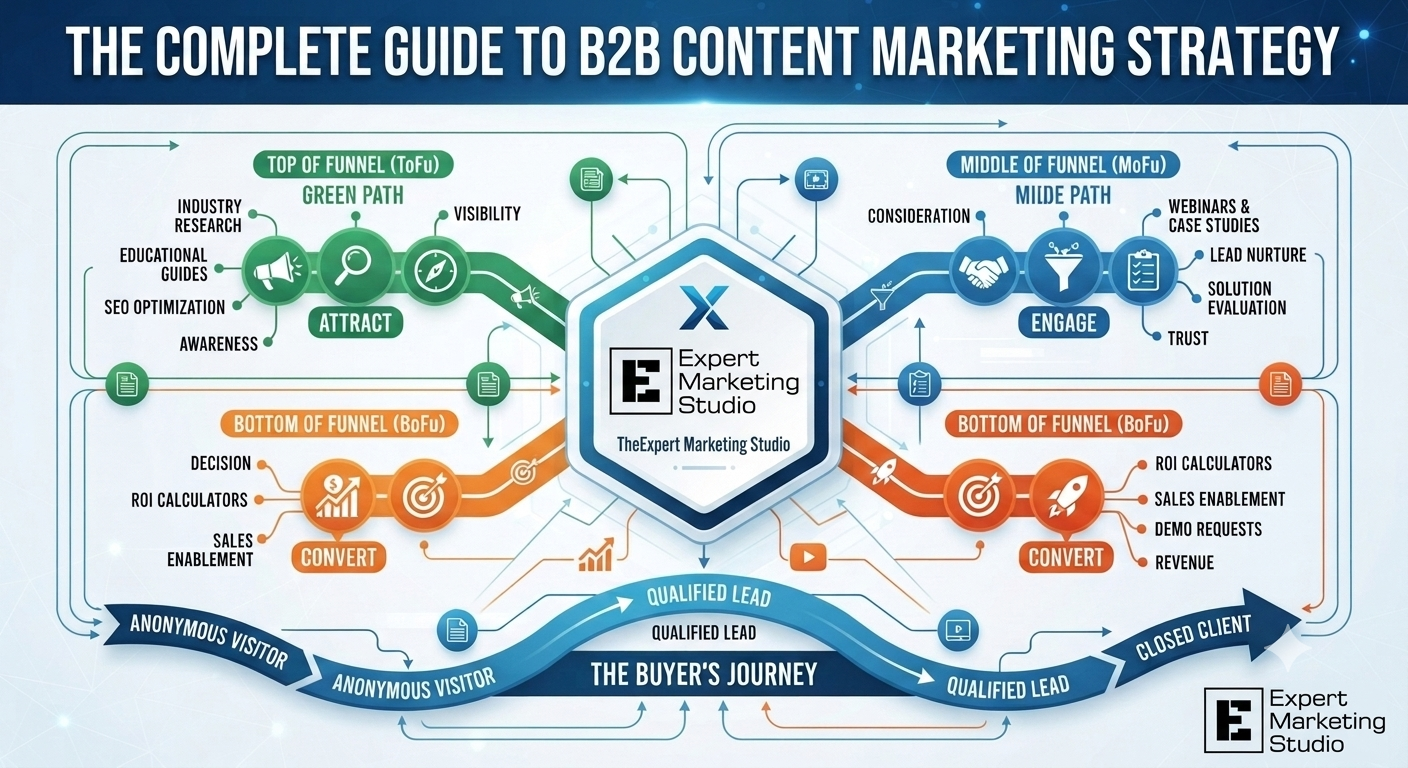
A balanced B2B content engine serves prospects at every stage of awareness, moving them smoothly from initial problem recognition to vendor selection:
Top of Funnel (ToFu): Problem Awareness & Industry Education
- Buyer Mindset: “We have a bottleneck or emerging risk, and we need to understand its root causes and industry best practices.”
- Primary Goal: Build brand visibility, earn trust, and establish category authority without aggressive pitching.
- Best Formats:
- Comprehensive educational guides and industry frameworks
- Original benchmark reports and annual state-of-the-industry surveys
- Executive thought leadership articles and contrarian market commentary
- Short-form educational videos and data-driven infographics
Middle of Funnel (MoFu): Solution Evaluation & Methodology
- Buyer Mindset: “We understand the problem; now we are evaluating different methodologies, frameworks, and vendor approaches to solve it.”
- Primary Goal: Demonstrate differentiated expertise, capture high-intent leads, and shape the buyer’s evaluation criteria.
- Best Formats:
- Detailed “How-To” implementation playbooks and step-by-step workflows
- Technical whitepapers and architectural deep dives
- Live or on-demand webinars featuring subject-matter experts and client panels
- Downloadable templates, audit checklists, and diagnostic frameworks
Bottom of Funnel (BoFu): Vendor Selection & Risk Mitigation
- Buyer Mindset: “We are comparing our top two or three shortlisted vendors and need proof of ROI, reliability, and smooth implementation.”
- Primary Goal: Eliminate perceived risk, equip internal champions to sell on your behalf, and accelerate deal velocity.
- Best Formats:
- Quantified customer case studies highlighting specific before-and-after business outcomes
- Transparent vendor comparison guides and “Alternative To” breakdowns
- Interactive ROI calculators and total-cost-of-ownership (TCO) models
- Pricing transparency guides, onboarding timelines, and security/compliance documentation
The Gated vs. Ungated Content Decision Framework
One of the most debated questions in B2B marketing is whether to put content behind a lead-capture form. Gating everything creates massive friction and prevents your best insights from being indexed by search engines or shared across buying committees. Conversely, leaving everything ungated can make it harder to capture early-stage contact data for email nurturing.
Apply a simple value-exchange rule:
- Keep Ungated: Blog posts, thought leadership, product documentation, comparison pages, and standard case studies. Maximize reach, organic rankings, and friction-free sharing.
- Gate Selectively: High-utility interactive tools (ROI calculators), customizable spreadsheet templates, proprietary primary research datasets, and live multi-speaker workshops where the immediate operational utility clearly outweighs the friction of submitting a work email.
5. Optimizing B2B Content for Traditional Search and AI Answer Engines (SEO, AEO & GEO)
In 2026, B2B discoverability requires a unified search strategy that spans three interconnected layers: traditional Search Engine Optimization (SEO), Answer Engine Optimization (AEO) for featured snippets and AI Overviews, and Generative Engine Optimization (GEO) for conversational AI platforms like ChatGPT, Gemini, and Perplexity.
Structuring Content for AI Citations and Extractability
Large language models and AI search engines retrieve, synthesize, and cite content differently than traditional ten-blue-link algorithms. To ensure your brand is cited as an authoritative source when buyers ask AI engines for vendor recommendations or strategic frameworks, engineer your pages for maximum extractability:
- Lead with Direct, Self-Contained Answers: Place a clear, concise 40-to-60-word summary immediately beneath every H2 and H3 heading before expanding into nuance. AI retrieval systems prioritize passages that directly answer a query without requiring surrounding context.
- Use Semantic HTML Hierarchy and Structured Tables: Organize complex comparisons, feature matrices, and multi-step processes into clean Markdown/HTML tables, numbered sequences, and bulleted lists. Structured data formats are dramatically easier for both human skimmers and AI parsers to extract accurately.
- Publish Proprietary Data and Named Frameworks: AI models heavily favor citing primary sources over secondary summaries. Conducting original surveys, publishing anonymized platform benchmarks, and coining proprietary methodologies (e.g., The Expert Marketing Studio 4-Stage Pipeline Framework) gives AI engines unique facts that can only be attributed to your brand.
- Reinforce E-E-A-T and Entity Signals: Clearly display author credentials, subject-matter expert (SME) reviewer bios, publication/update dates, and organization schema markup. Connecting your content to verifiable human experts strengthens Experience, Expertise, Authoritativeness, and Trustworthiness (E-E-A-T).
6. Building a Scalable B2B Content Production Engine
Consistency is the hardest part of B2B content marketing. Without a repeatable editorial workflow, content calendars collapse whenever product launches or quarterly emergencies arise.
Extracting Expertise from Busy Subject-Matter Experts (SMEs)
The greatest competitive advantage a B2B company possesses is the internal knowledge of its founders, engineers,strategists, and customer success leaders. However, asking busy executives or technical architects to write 2,500-word articles from scratch rarely works.
Instead, implement an Interview-Driven Editorial Workflow:
- The Strategic Brief: The content strategist creates a detailed brief outlining target persona, search/AI intent, core thesis, H2/H3 structure, internal links, and specific questions for the SME.
- The 30-Minute SME Extraction Call: A skilled content writer or strategist interviews the internal expert for 30 minutes, recording the conversation and probing for real-world war stories, tactical nuances, and common client mistakes.
- Drafting and Editorial Polish: The writer transforms the transcript into a structured, authoritative long-form asset,weaving in supporting data, visuals, and clear calls to action.
- Rapid SME Verification: The SME spends 10 minutes reviewing the draft for technical accuracy rather than staring at a blank page.
Leveraging AI Responsibly in the Production Workflow
Generative AI is a powerful force multiplier when paired with human strategy, and a brand liability when used as an autopilot replacement. Use AI tools to accelerate research synthesis, transcript structuring, outline stress-testing, metadata generation, and multi-channel repurposing—while keeping human experts strictly in charge of strategic positioning, original insights, fact verification, and brand voice.
7. The Waterfall Distribution and Repurposing Framework
Creating an exceptional 3,000-word pillar guide or original research report is only half the equation. To maximize return on effort, adopt the Waterfall Content Distribution Strategy—systematically breaking down every flagship asset into dozens of native micro-assets tailored to specific channels.
Turning One Flagship Asset into 15+ Touchpoints
When you publish a major piece of cornerstone content, execute a coordinated 30-day distribution sprint across four core channels:
- Executive-Led LinkedIn Distribution: B2B buyers follow people, not corporate logos. Transform the key insights from your pillar article into:
- 3–4 text-based thought leadership posts published from your CEO’s or department heads’ personal profiles.
- 1 high-design PDF carousel summarizing the core framework visually.
- 1 short-form native video clip explaining the most counterintuitive takeaway.
- Segmented Email Newsletter & Nurture Sequences: Send a high-value editorial breakdown to your subscriber list—delivering the core insight directly inside the email body rather than just dropping a “check out our latest blog” link. Integrate bottom-of-funnel cluster assets into automated lifecycle nurture tracks.
- Sales Enablement Activation: Notify your sales team in Slack or Teams every time a new asset goes live,complete with a three-bullet summary of who the piece is for, which objection it solves, and a copy-paste email snippet reps can use in active deal follow-ups.
- Community, Partner, and Digital PR Syndication: Pitch original data findings to industry newsletters, co-market adjacent topics with non-competing technology partners, and share genuinely helpful excerpts in relevant Slack communities, LinkedIn groups, and industry forums.
8. Measuring B2B Content Marketing ROI and Pipeline Attribution
To protect and grow your content budget, you must report on metrics that resonate with the C-suite. While leading indicators help your team optimize day-to-day execution, lagging commercial metrics prove financial return.
Leading Indicators vs. Lagging Revenue Metrics
| Metric Tier | Key Metrics to Track | What It Tells You |
|---|---|---|
| Leading Indicators (Visibility & Engagement) | Non-branded organic impressions, AI search citation share, scroll depth, engaged reading time, returning visitor rate, newsletter subscriber growth. | Whether your content is successfully reaching your target ICP and holding their attention during self-directed research. |
| Mid-Funnel Indicators (Demand & Intent) | High-intent page views (pricing, case studies, comparisons), demo/consultation requests, webinar attendance, content downloads from target accounts. | Whether your educational content is converting passive readers into active evaluators. |
| Lagging Indicators (Pipeline & Revenue) | Content-Sourced Pipeline (deals where content was the first touch), Content-Influenced Pipeline (closed-won deals that engaged with content prior to signing), sales cycle velocity, customer acquisition cost (CAC) reduction. | The direct dollar impact of your content marketing program on company revenue. |
Implementing Hybrid Attribution
Because B2B buying journeys span months and involve dark-social touchpoints (such as a colleague sharing a link in a private Slack channel or mentioning a podcast on a call), single-touch software attribution alone never tells the full story.Combine multi-touch CRM attribution (tracking first-touch and pre-opportunity content engagements in HubSpot or Salesforce) with self-reported attribution—adding a mandatory “How did you first hear about us?” open-text field on your demo request form. Pairing quantitative analytics with qualitative buyer self-reporting gives leadership an undeniable view of how content drives demand.
9. Your 90-Day B2B Content Execution Roadmap
Building an enterprise-grade content engine does not happen overnight, but disciplined execution over a single quarter can establish momentum that compounds for years.
- Days 1–30: Foundation, Audit, and Architecture
- Align with executive leadership and sales on commercial goals, ICP definitions, and buying committee pain points.
- Complete your four-bucket content audit and competitive gap analysis.
- Select your first two core Content Pillars and map out 8–10 supporting cluster topics across ToFu, MoFu, and BoFu stages.
- Days 31–60: Production and On-Page Optimization
- Conduct SME extraction interviews and produce your first flagship Pillar Page alongside four supporting cluster articles and one quantified case study.
- Refresh your top three decaying legacy blog posts with updated 2026 benchmarks and AI-extractable formatting.
- Establish bidirectional internal linking across your new topic cluster.
- Days 61–90: Distribution Sprint and Attribution Setup
- Launch your Waterfall Distribution cadence across executive LinkedIn profiles, segmented email newsletters,and sales enablement playbooks.
- Configure CRM campaign tracking and self-reported attribution fields to monitor pipeline influence.
- Conduct a 90-day retrospective to double down on top-converting formats and plan your next quarterly pillar.
Turn Your Expertise into Predictable B2B Pipeline
The most successful B2B brands do not win by shouting the loudest—they win by becoming the most trusted, helpful,and authoritative resource in their category long before a buyer ever fills out a contact form. When you align deep customer empathy with structured pillar architecture, AI-ready formatting, and disciplined multi-channel distribution, content marketing transforms from a cost center into your most reliable growth asset.