Leveraging Marketing Automation to Boost Customer Retention:
The Complete Playbook for Modern Brands
By Expert Marketing Studio
For years, the dominant growth playbook in digital marketing followed a predictable, linear formula: pour budget into paid acquisition, fill the top of the funnel, convert a fraction of those leads, and repeat the cycle every quarter. While customer acquisition remains essential for market expansion, relying on it as your primary growth engine in 2026 has become increasingly expensive and unsustainable. Rising cost-per-click (CPC) rates across paid search and social channels, stricter privacy regulations that limit third-party targeting, and an oversaturated digital landscape mean that acquiring a new customer costs significantly more than keeping an existing one.
At Expert Marketing Studio, we see a clear dividing line between businesses that plateau and businesses that compound their revenue year over year. The companies that win are not merely better at acquiring customers—they are relentless about keeping them. When you increase customer retention rates by even 5%, profits can rise between 25% and 95%,driven by higher Customer Lifetime Value (CLV), lower servicing costs, and organic word-of-mouth referrals.
Yet, delivering a deeply personal, attentive post-purchase experience to hundreds, thousands, or millions of customers is impossible to execute manually. A human team cannot remember every customer’s purchase anniversary, spot subtle drops in product usage at 2:00 AM, or send a tailored replenishment reminder the exact week a buyer runs low on a consumable product.
That is where marketing automation transforms retention from a reactive customer support task into a proactive,revenue-generating growth system. When architected properly, marketing automation does not replace the human element of your brand—it scales your empathy, precision, and relevance across every stage of the customer lifecycle.
In this comprehensive guide, the strategy team at Expert Marketing Studio breaks down how to design, build, and optimize a retention-focused marketing automation engine that turns one-time buyers into lifelong brand advocates.
1. The Strategic Shift: Moving From Funnel Thinking to Lifecycle Architecture
Traditional marketing treats the purchase as the finish line. Once a prospect converts, marketing hands the baton off to customer service and moves on to hunt for the next lead. In reality, the moment a customer completes their first transaction is the starting line of the relationship.
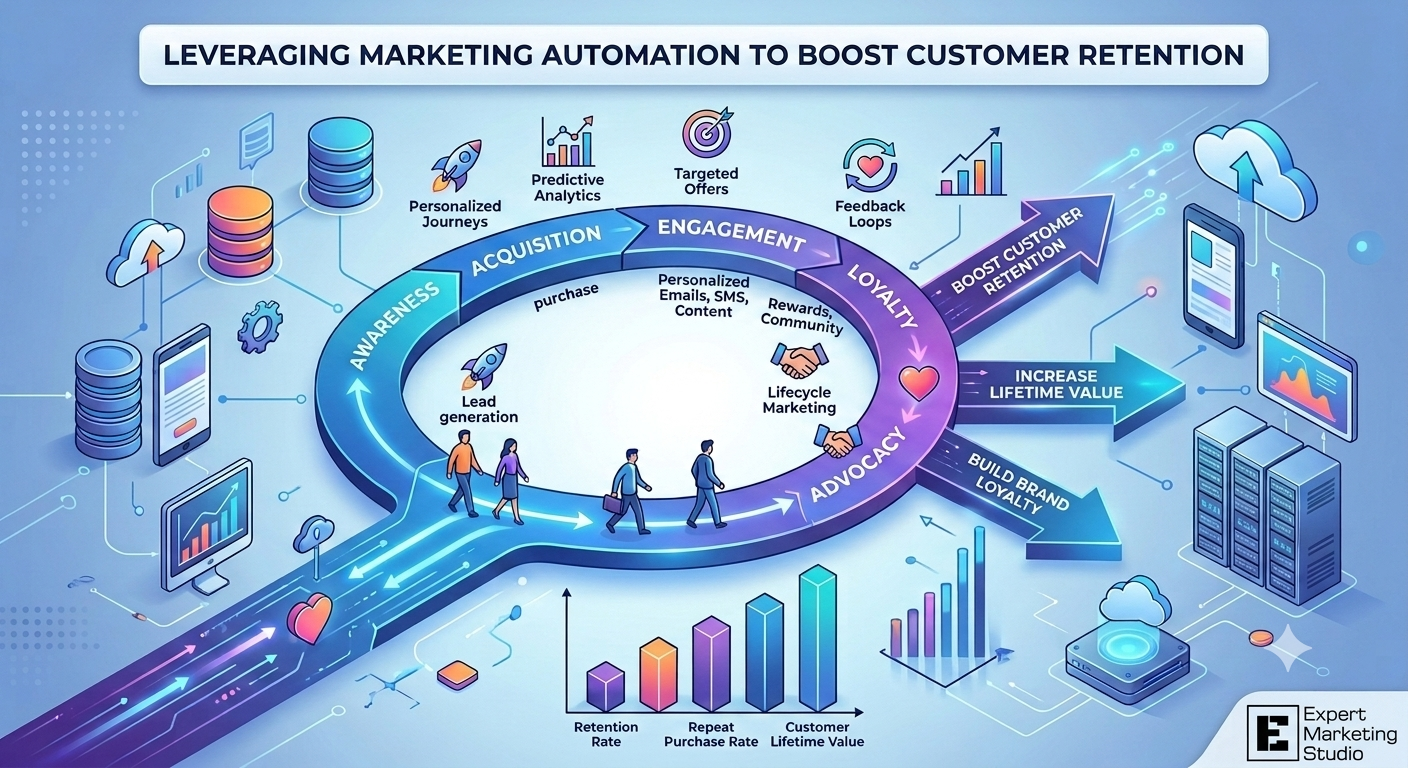
To leverage marketing automation for retention, your organization must shift from linear funnel thinking to cyclical lifecycle architecture. Instead of asking, “How do we get more leads?” your core strategic question becomes, “How do we continuously deliver value after the sale so that staying with us is the obvious choice?”
Acquisition Marketing vs. Retention Marketing
Understanding the operational difference between acquisition and retention is critical before building automated workflows.
| Dimension | Acquisition Marketing | Retention Marketing |
|---|---|---|
| Primary Objective | Convert prospects into first-time buyers | Maximize repeat purchases, expansion, and advocacy |
| Core Data Inputs | Demographics, intent keywords, lookalike audiences, ad clicks | First-party behavioral data, purchase history, product usage, support tickets |
| Messaging Tone | Persuasive, promotional, value-proving | Educational, supportive, consultative, celebratory |
| Automation Triggers | Form fills, page views, ad engagements | Order completions, feature milestones, inactivity thresholds, renewal dates |
| Key Success Metrics | Customer Acquisition Cost (CAC), Conversion Rate, ROAS | Customer Retention Rate (CRR), Churn Rate, CLV, Net Revenue Retention (NRR) |
When marketing automation is applied solely to acquisition, brands often fall into the trap of “batch-and-blast” promotional emails—sending the exact same discount code to a brand-new buyer, a five-year VIP, and a customer currently waiting on a refund. That kind of tone-deaf messaging actively erodes trust and accelerates churn. True retention automation listens to customer behavior first and speaks second.
2. Laying the Data Foundation: The 360-Degree Customer Profile
Marketing automation is only as intelligent as the data feeding it. If your e-commerce store, CRM, customer support desk,and product analytics operate in isolated silos, your automation platform will make embarrassing mistakes—such as recommending a product the customer bought three days ago or sending an upsell offer while an urgent support ticket remains unresolved.
Before building a single automated sequence, Expert Marketing Studio recommends establishing a unified 360-degree customer profile through a Customer Data Platform (CDP) or deeply integrated CRM ecosystem.
Four Pillars of Retention Data
- Transactional Data: What did the customer buy, when did they buy it, how much did they spend, what is their average order value (AOV), and did they use a discount code?
- Behavioral & Engagement Data: Which pages do they browse? Which emails do they open or ignore? How frequently do they log into your app or platform, and which features do they use most?
- Service & Sentiment Data: Have they contacted customer support recently? What was their Net Promoter Score (NPS) or Customer Satisfaction (CSAT) rating? Have they left a product review?
- Zero-Party Data: Preferences the customer explicitly shares with you—such as skin type, dietary goals, company size, communication channel preferences, or birthday.
Dynamic Segmentation with RFM Modeling
Once your data flows into a central hub, you can replace static email lists with dynamic behavioral segments. One of the most effective frameworks for retention automation is RFM Analysis (Recency, Frequency, Monetary Value):
- Recency (R): How recently did the customer make a purchase or engage with your brand?
- Frequency (F): How often do they buy or log in over a given period?
- Monetary Value (M): How much revenue do they generate compared to your average buyer?
By scoring customers across these three dimensions, your marketing automation platform can automatically route individuals into living segments—and shift them between workflows in real time as their behavior evolves:
- Champions (High R, High F, High M): Your best customers. Route them into VIP loyalty tiers, early-access product drops, and referral advocacy workflows.
- Loyalists (Moderate-to-High R, High F): Consistent buyers who respond well to personalized cross-sells,subscription upgrades, and educational content.
- Promising Newcomers (High R, Low F): Recent first-time buyers in the critical 30-to-60-day onboarding window where habits are formed.
- At-Risk Customers (Low R, Previously High F/M): Historically valuable buyers whose engagement or order frequency has slipped past their normal cadence. Trigger proactive check-ins and targeted win-back flows before they churn completely.
3. High-Impact Automated Workflows Across the Customer Lifecycle
With clean data and dynamic segmentation in place, you can deploy targeted automation workflows mapped to specific moments in the customer journey. Below are the seven core retention workflows every growth-focused brand should implement.
Workflow 1: The Value-First Post-Purchase Onboarding Series
Buyer’s remorse is highest in the hours and days immediately following a purchase. If a customer buys a complex SaaS tool, a skincare regimen, or a piece of hardware and feels overwhelmed or confused, they will quietly abandon it—and never buy again.
An automated post-purchase onboarding workflow bridges the gap between transaction and value realization.
- Trigger: First purchase completed or account created.
- Cadence & Structure:
- Day 0 (Immediate): Order confirmation paired with a warm brand welcome, clear expectations on shipping or setup, and zero hard selling.
- Day 2–3 (The “Quick Win” Guide): Deliver bite-sized educational content tailored to the exact item purchased—such as a 60-second setup video, styling tips, or a “First 3 Steps” checklist so the customer experiences their first success quickly.
- Day 7–10 (Pro Tips & Hidden Value): Highlight advanced features, care instructions, or complementary use cases that deepen product adoption.
- Day 14 (Support Check-In): A plain-text email appearing to come directly from a Customer Success Manager asking, “How are you getting on with [Product Name]? Reply directly if you have any questions.”
Expert Tip: Suppress all promotional blast emails while a customer is actively moving through their initial 14-day onboarding sequence. Let them fall in love with what they already bought before asking them to buy again.
Workflow 2: Behavioral Feature Adoption & Milestone Nudges
In subscription and SaaS businesses, retention is directly tied to product stickiness. Data consistently shows that users who adopt three or more core features within their first month retain at multiples higher than users who only engage with a single basic feature.
Instead of relying on manual account management, use event-based triggers to guide users toward deeper engagement:
- Trigger: User completes Action A (e.g., connects their calendar) but has not completed Action B (e.g., automated a booking link) within 7 days.
- Action: Trigger an in-app tooltip or targeted email showing a 30-second GIF of how Action B saves 3 hours a week, complete with a deep link that takes them straight to that feature screen.
- Celebration Triggers: When a user hits a meaningful milestone—such as their 10th workout logged, 1,000th email sent, or 1-year anniversary—trigger a celebratory message highlighting their personal usage stats. Quantifying the value they have gained reinforces why your product is indispensable.
Workflow 3: Predictive Replenishment & Reorder Reminders
For e-commerce brands selling consumables—coffee, supplements, cosmetics, pet food, cleaning supplies, or printer ink—forgetting to reorder is one of the primary drivers of silent churn. Customers rarely switch brands out of anger; they switch because they ran out on a Tuesday morning and grabbed whatever was available at the local store.
Marketing automation solves this through predictive replenishment timing:
- Trigger: Calculate the average consumption window for each SKU (e.g., a 30-day supply of vitamins). Trigger the reminder at Day 23—just before the customer runs dry.
- Action: Send a personalized SMS or email featuring the exact product they ordered, a one-click reorder link pre-loaded with their shipping details, and an option to convert their order into an auto-replenish subscription for a 10% savings.
- Dynamic Adjustment: If a customer historically reorders every 42 days instead of 30, smart automation platforms dynamically adjust the trigger window to match that individual’s consumption pace.
Workflow 4: Contextual Cross-Sell & Upsell Recommendations
Existing customers are significantly more likely to convert on a new offer than cold prospects—provided the recommendation feels genuinely helpful rather than opportunistic.
- Trigger: 14 to 30 days after a confirmed delivery, conditioned on a positive post-purchase review or absence of open support tickets.
- Action: Use purchase-affinity logic to recommend the logical next step. If a customer bought a DSLR camera body,suggest a versatile prime lens or protective bag—never another camera body. Frame the message around completing their experience (“Get even more out of your new setup”) rather than pushing inventory.
Workflow 5: Automated Voice of Customer (VoC) & Review Loops
Customers stay loyal to brands that listen. Automated feedback loops serve a dual purpose: they capture valuable social proof from happy buyers and act as an early-warning radar for dissatisfied ones.
- Trigger: 10 to 21 days post-delivery (timed so the customer has actually used the product, while enthusiasm is still fresh).
- Branching Logic:
- Path A (4- or 5-Star Rating / NPS 9–10): Automatically thank the customer, invite them to post their review publicly on Google, Trustpilot, or your product page, and introduce your referral program reward.
- Path B (1- to 3-Star Rating / NPS 0–6): Immediately suppress all marketing promotions for this contact,trigger an empathetic apology email, and auto-create a high-priority ticket in Zendesk or HubSpot so a human specialist can reach out within hours to make things right.
Workflow 6: Proactive Churn Prevention & Win-Back Sequences
By the time a customer clicks “Cancel Subscription” or goes six months without a purchase, winning them back is an uphill battle. The smartest retention engines detect early decay signals—declining email engagement, fewer logins,skipped subscription deliveries, or browsing cancellation policy pages—and intervene before the relationship breaks.
- The Pre-Churn Check-In (30–45 Days of Inactivity): Send a low-friction, high-value touchpoint—a curated roundup of new features, a helpful industry guide, or a quick two-question preference survey asking what topics or products they want to see more of.
- The Value-Reminder Win-Back (60–90 Days of Inactivity): Remind the customer of what they are missing, showcase social proof or new arrivals tailored to their past browsing categories, and offer a modest, time-bound incentive.
- The Sunset / List-Hygiene Flow (120+ Days of Inactivity): If a subscriber stops engaging entirely, send a transparent “Should we stay in touch?” message giving them the choice to update their frequency preferences or opt out. Maintaining clean engagement protects your sender reputation so your emails actually reach the inboxes of active customers.
Workflow 7: Automated Cancellation Deflection & Dunning Recovery
Not all churn is intentional. In subscription businesses, involuntary churn—caused by expired credit cards, insufficient funds, or bank declines—frequently accounts for 20% to 40% of lost customers.
- Smart Dunning Automation: Pair intelligent payment retry logic with a multi-channel dunning sequence (email + SMS + in-app banner). Keep the tone helpful rather than punitive (“Oops—looks like your card expired! Update your payment details in 10 seconds to keep your VIP perks uninterrupted”).
- Personalized Cancellation Flows: When a user initiates cancellation, trigger an automated micro-survey asking why they are leaving, paired with a tailored counter-offer:
- Too much product? Offer to pause or extend their delivery interval from 30 days to 60 days.
- Too expensive? Offer a temporary loyalty discount or a downgrade to a lighter tier.
- Missing a feature? Route feedback directly to your product team and offer a 1-on-1 onboarding call.
4. Orchestrating an Omnichannel Retention Experience
Email remains the backbone of retention marketing due to its unmatched ROI and room for rich storytelling, but relying on a single channel limits your reach. Modern consumers move fluidly between their inbox, mobile lock screen, social feeds, and website.
True omnichannel automation ensures that every channel reinforces the others without bombarding the customer with duplicate messages:
- Email: Best for in-depth onboarding guides, monthly usage recaps, curated product recommendations, and loyalty tier updates.
- SMS & WhatsApp: High-urgency, high-open-rate channels reserved for shipping alerts, replenishment reminders,VIP flash access, and urgent billing updates. Always enforce strict frequency caps (e.g., no more than 2–4 promotional texts per month).
- In-App Messaging & Push Notifications: Ideal for contextual nudges while the user is actively engaging with your digital product—such as celebrating a streak or guiding feature discovery.
- On-Site Website Personalization: When a known customer returns to your website, dynamically tailor the homepage banner to reflect their loyalty points balance, recently viewed categories, or subscription status.
- Paid Media Suppression & Retargeting: Sync your CRM segments directly with Meta, Google, and LinkedIn Ads. Automatically exclude recently converted customers from top-of-funnel acquisition ads (saving wasted ad spend), while serving targeted loyalty or new-feature campaigns exclusively to high-value retention segments.
The Golden Rule of Omnichannel Orchestration: Use conditional “if/else” branching so channels work in sequence rather than simultaneously. For example, send a replenishment reminder via email first; only trigger an SMS follow-up 48 hours later if the email went unopened and no order was placed.
5. Leveraging AI and Predictive Analytics in Retention Automation
In 2026, marketing automation has evolved well beyond rigid, manual “if-this-then-that” rules. Modern platforms embed machine learning and generative AI directly into the lifecycle engine, enabling brands to anticipate customer needs before the customer even articulates them.
Four Ways AI Elevates Retention
- Predictive Churn Scoring: AI models analyze dozens of micro-signals—slight decreases in session duration,slower email open latencies, changes in basket size—to assign every customer a real-time churn probability score.When a high-CLV customer crosses a risk threshold, automation can trigger a personalized retention offer or alert a human account manager immediately.
- Send-Time Optimization (STO): Rather than blasting an entire segment at 9:00 AM, AI tracks when each individual subscriber historically opens and clicks messages, holding their email until their personal peak engagement window.
- Next-Best-Action & Product Affinity Engines: Machine learning evaluates millions of historical purchase paths across your catalog to predict the single product, content piece, or incentive most likely to drive the next conversion for each unique buyer.
- AI-Assisted Conversational Support: Modern AI chatbots integrated with your CRM and order management system can resolve routine post-purchase questions—order tracking, return labels, subscription pauses—24/7 with full awareness of the customer’s purchase history, seamlessly escalating complex issues to human agents with full context attached.
6. Measuring What Matters: Retention KPIs and Attribution
You cannot optimize what you do not measure. While open rates and click-through rates serve as useful diagnostic pulse checks for individual emails, executive retention reporting must anchor on bottom-line business metrics.
Essential Retention Metrics to Track
- Customer Retention Rate (CRR): The percentage of existing customers who remain active over a defined period.CRR=(Customers at Start of PeriodCustomers at End of Period−New Customers Acquired)×100
- Customer Churn Rate: The inverse of retention—the percentage of customers who cancel or lapse during a given timeframe.
- Repeat Purchase Rate (RPR): Particularly vital for e-commerce brands; measures the percentage of your total customer base that has placed two or more orders.
- Customer Lifetime Value (CLV): The total net profit a business can reasonably expect from a single customer account throughout the entire relationship. Comparing CLV to CAC (aiming for a ratio of 3:1 or higher) reveals the true health of your growth model.
- Net Revenue Retention (NRR): The gold-standard metric for SaaS and subscription companies. NRR measures total recurring revenue retained from existing customers—accounting for upgrades, cross-sells, downgrades, and churn. An NRR above 100% means your existing customer base is growing revenue organically even without adding a single new logo.
Proving Incrementality with Holdout Groups
One of the most common mistakes in retention marketing is attributing organic repeat orders to an automated email simply because the customer happened to open it before buying. At Expert Marketing Studio, we validate true automation lift using universal holdout groups:
- Set aside a randomized 5% to 10% control group of customers who do not receive a specific automated retention flow (while still receiving essential transactional receipts).
- Compare the 60-day and 90-day repeat purchase rates, AOV, and churn rates of the automated group against the holdout group.
- The difference between the two cohorts represents the true incremental revenue generated by your marketing automation engine.
7. Common Retention Automation Pitfalls (and How to Avoid Them)
Even sophisticated marketing teams can undermine their retention goals if automation is implemented without guardrails.Watch out for these five common traps:
- Over-Automating the Human Touch: Automation should handle scale and timing, not hide your brand behind robotic walls. Always provide a clear, frictionless path to reach a real human being—especially when a customer is frustrated, requesting a refund, or making a high-value decision.
- Training Customers to Wait for Discounts: If every lapsed-customer workflow automatically fires off a 20% coupon at Day 45, savvy shoppers will quickly learn to delay their purchases to trigger the discount. Lead with value, education, loyalty points, and exclusivity before resorting to margin-eroding markdowns.
- Ignoring Workflow Collisions: Without global frequency caps and priority rules, a single customer could simultaneously qualify for a browse-abandonment flow, a loyalty tier upgrade email, a weekly newsletter, and a feedback request on the same afternoon. Establish clear hierarchy rules so high-priority lifecycle triggers temporarily pause routine promotional sends.
- Treating Automation as “Set-and-Forget”: Product lines change, customer expectations shift, and creative fatigue sets in. Audit your core retention flows quarterly—reviewing step-by-step drop-off rates, testing fresh subject lines and offers, and retiring outdated messaging.
- Personalizing Without Permission or Context: Just because you have a data point doesn’t mean you should expose it awkwardly. Creepy hyper-targeting (“We noticed you stared at blue socks for 4 minutes at 11:42 PM”) backfires. Keep personalization helpful, natural, and transparent.
8. A 90-Day Implementation Roadmap for Your Brand
Building a world-class retention automation engine does not happen overnight, nor does it require launching thirty workflows at once. Follow this phased 90-day rollout plan to build momentum and capture quick wins:
Days 1–30: Audit, Integrate, and Clean
- Audit your existing post-purchase touchpoints to identify where customers currently drop off or submit repetitive support tickets.
- Connect your e-commerce/product platform, CRM, email/SMS provider, and support desk so behavioral and transactional data sync cleanly.
- Build your foundational RFM and lifecycle stage segments.
Days 31–60: Launch Core Lifecycle Flows
- Deploy your Post-Purchase Onboarding Series to eliminate buyer’s remorse and accelerate time-to-value.
- Activate your Automated Review & VoC Feedback Loop to capture social proof and intercept unhappy customers early.
- Implement Dunning / Failed Payment Recovery (for subscriptions) or Predictive Replenishment Flows (for consumables) for immediate revenue protection.
Days 61–90: Expand, Personalize, and Optimize
- Launch Contextual Cross-Sell and At-Risk Win-Back workflows powered by purchase history and engagement decay triggers.
- Introduce secondary channels (SMS, in-app nudges, paid ad suppression) with frequency guardrails.
- Set up holdout testing and a monthly retention KPI dashboard tracking CRR, Repeat Purchase Rate, and CLV.
Turn Your Existing Customers Into Your Most Predictable Growth Engine
Acquisition gets you into the game, but retention is how you win it. Every customer you have already earned represents hard-won trust, proven product-market fit, and immense untapped lifetime value. By pairing clean first-party data with thoughtful, empathetic marketing automation, your brand can deliver timely, relevant experiences at scale—turning casual buyers into vocal champions who stay longer, spend more, and bring their friends along.
Ready to transform your post-purchase customer journey? At Expert Marketing Studio, we partner with ambitious brands to audit lifecycle gaps, architect full-funnel CRM and marketing automation ecosystems, and engineer retention workflows that measurably increase Customer Lifetime Value. Reach out to our digital strategy team today to schedule a complimentary Retention & Automation Audit and discover how much recurring revenue is hiding inside your existing customer base.